|
|
|
||
|
|
|
|

MAE SOT — It has now been 10 days since the Burmese military regime closed the Thai-Burma border crossing that connects Mae Sot, Thailand with Myawaddy, Burma. Although purportedly in protest of Thailand building an embankment on the Thai side of the Moei River, which marks the border, the closing is also intended to pressure the Democratic Karen Buddhist Army (DKBA) to join the junta's border guard force (BGF), according to sources. Not only has the junta halted border trade in goods by shutting down all known trade routes, it has prohibited people from entering Burma from Thailand and blocked their ability to cross the Moei River at the official Friendship Bridge crossing and at more than 20 well-known unofficial river crossings.
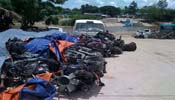
Burmese officials initially shut down the Friendship Bridge checkpoint following a June 8 visit to Myawaddy by the chairman of the Karen State Peace and Development Council, Brig-Gen Zaw Min. The junta has briefly closed the border checkpoint nine times since, but the current closure is the longest to date. On the Thai side of the river, the stockpile of second-hand cars, bicycles, automobile parts, consumer electronics, vegetable oil and other goods for import into Burma is growing by the day. On the Burmese side, goods meant to be bound for Mae Sot, including foodstuffs such as onions, potatoes, dried chillies, seafood and rice, and consumer goods such as Burmese crafts, traditional medicines, textiles and jade are also sitting idle, and in some cases rotting. The loss in cross-border trade since last week is estimated to be US $2.7 million per day, and if the border remains closed into August the loss will exceed $30 million, according to an estimate by Mae Sot District's chamber of commerce. Thailand is actively seeking to reopen the border at Mae Sot, and on Monday, Thai Deputy Commerce Minister Alongkorn Ponlaboot led a Thai delegation of civil servants and persons with local business interests in a two-hour meeting held in Myawaddy with Burmese Deputy Foreign Minister Maung Myint. According to a report in the Bangkok Post, one of Thailand's leading English language newspapers, Thailand initiated the talks in hopes of convincing Burma to separate the embankment issue from the issue of trade between the two countries, but Burma insisted during the meeting that it would keep the border closed. Both sides have said that on Friday they will continue talks on opening the border before the Joint Boundary Committee, but many observers told The Irrawaddy that this is a “made up” story. Standing in a compound holding his rapidly growing stockpile of inventory, an Indian-Burmese trader pointed across the river to Shwe Koko, the headquarters of DKBA Special Battalion 999, which is controlled by Battalion Commander Col Chit Thu, who is now believed to be the most powerful man in the DKBA. “Burmese troops are now posted at the checkpoint the DKBA had controlled for many years,” he said. For more than one year, Naypyidaw has pressured all ethnic cease-fire groups such as the DKBA to transform their army into a member of the BGF, and the regime has set a final deadline of Aug 10 for the DKBA to agree to join. Despite the junta's claim that the border closure relates to the Thai embankment, some observers believe the border closing is a muscle-flexing tactic by Burma's military regime, designed to demonstrate to DKBA leaders that Naypyidaw controls their income source, thereby forcing the DKBA to join the BGF. Border sources say that most DKBA leaders are not interested in politics, only in business, and are hoping to maintain their business interests in logging, automobiles and mined minerals such as zinc and tin, as well as building factories and other business enterprises. 1 | 2  COMMENTS (3) COMMENTS (3)
|
  Thailand Hotels Bangkok Hotels China Hotels India Hotels
|
| Home |News |Regional |Business |Opinion |Multimedia |Special Feature |Interview |Magazine |Burmese Elections 2010 |Archives |Research |
| Copyright © 2008 Irrawaddy Publishing Group. All Rights Reserved. |


 E-MAIL
 PRINT
PRINT

 Slide Show (