
| By YENI | Thursday, July 29, 2010 |
MAE SOT — It has now been 10 days since the Burmese military regime closed the Thai-Burma border crossing that connects Mae Sot, Thailand with Myawaddy, Burma. Although purportedly in protest of Thailand building an embankment on the Thai side of the Moei River, which marks the border, the closing is also intended to pressure the Democratic Karen Buddhist Army (DKBA) to join the junta's border guard force (BGF), according to sources.
Not only has the junta halted border trade in goods by shutting down all known trade routes, it has prohibited people from entering Burma from Thailand and blocked their ability to cross the Moei River at the official Friendship Bridge crossing and at more than 20 well-known unofficial river crossings.
  Slide Show (View) Slide Show (View) |
Burmese officials initially shut down the Friendship Bridge checkpoint following a June 8 visit to Myawaddy by the chairman of the Karen State Peace and Development Council, Brig-Gen Zaw Min. The junta has briefly closed the border checkpoint nine times since, but the current closure is the longest to date.
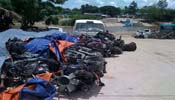
On the Thai side of the river, the stockpile of second-hand cars, bicycles, automobile parts, consumer electronics, vegetable oil and other goods for import into Burma is growing by the day. On the Burmese side, goods meant to be bound for Mae Sot, including foodstuffs such as onions, potatoes, dried chillies, seafood and rice, and consumer goods such as Burmese crafts, traditional medicines, textiles and jade are also sitting idle, and in some cases rotting.
The loss in cross-border trade since last week is estimated to be US $2.7 million per day, and if the border remains closed into August the loss will exceed $30 million, according to an estimate by Mae Sot District's chamber of commerce.
Thailand is actively seeking to reopen the border at Mae Sot, and on Monday, Thai Deputy Commerce Minister Alongkorn Ponlaboot led a Thai delegation of civil servants and persons with local business interests in a two-hour meeting held in Myawaddy with Burmese Deputy Foreign Minister Maung Myint.
According to a report in the Bangkok Post, one of Thailand's leading English language newspapers, Thailand initiated the talks in hopes of convincing Burma to separate the embankment issue from the issue of trade between the two countries, but Burma insisted during the meeting that it would keep the border closed.
Both sides have said that on Friday they will continue talks on opening the border before the Joint Boundary Committee, but many observers told The Irrawaddy that this is a “made up” story.
Standing in a compound holding his rapidly growing stockpile of inventory, an Indian-Burmese trader pointed across the river to Shwe Koko, the headquarters of DKBA Special Battalion 999, which is controlled by Battalion Commander Col Chit Thu, who is now believed to be the most powerful man in the DKBA. “Burmese troops are now posted at the checkpoint the DKBA had controlled for many years,” he said.
For more than one year, Naypyidaw has pressured all ethnic cease-fire groups such as the DKBA to transform their army into a member of the BGF, and the regime has set a final deadline of Aug 10 for the DKBA to agree to join.
Despite the junta's claim that the border closure relates to the Thai embankment, some observers believe the border closing is a muscle-flexing tactic by Burma's military regime, designed to demonstrate to DKBA leaders that Naypyidaw controls their income source, thereby forcing the DKBA to join the BGF.
Border sources say that most DKBA leaders are not interested in politics, only in business, and are hoping to maintain their business interests in logging, automobiles and mined minerals such as zinc and tin, as well as building factories and other business enterprises.
Therefore, sources said that both Chit Thu and Gen Kyaw Than, the DKBA commander in chief, both of whom have substantial interests in cross-border trade, have agreed to join the BGF, and once the DKBA transforms into a member of the BGF the border will be reopened.
However, sources said that future border trade will be controlled directly by the Myanmar Federation of Chambers of Commerce and Industry, functioning together with the Department of Border Trade, locally known as Na Sa Ka, which combines units from the army, police, customs and immigration authorities.
In addition, the DKBA is still divided on joining the BGF. One DKBA commander who has refused to join is Col Saw Lah Pwe, known as Mr. Beard, who controls part of the area near the Thai border town of Phop Phra, located north of Mae Sot.
On July 21, Saw Lah Pwe declined an offer by Lt-Gen Ye Myint, the regime's chief of Military Affairs Security, to meet and discuss the BGF plan. And according to recent reports, Saw Lah Pwe's troops, which are based near the Three Pagodas Pass and in Kyar Inn Seik Gyi and Kawkareik Townships in Karen State, have already defected to the Karen National Liberation Army (KNLA), an armed ethnic group, from whom the DKBA split in 1994, that is still actively fighting Burma's military regime.
Sources said the Burmese regime deployed 400 troops near Kyar Inn Seik Gyi Township last week, and the Thai army, concerned that refugees will flood its borders if armed conflict breaks out, has reportedly reinforced its security along the Thai-Burmese border.
On Sunday, about 700 villagers from Karen State fled to the Thai border due to fear of clashes between the Burmese army and the DKBA amid news that Saw Lah Pwe had rejected the BGF plan. However, the latest reports from Karen border sources said some of the villagers returned home on Monday morning.
Thai authorities said they did not deport the refugees, but advised them that they cannot stay in refugee camps inside Thailand unless actual fighting breaks out. Under current Thai policy, displaced Karen fleeing from conflict are permitted to stay in Thailand only temporarily. When the fighting stops, they are expected to go back to Burma.
On both the Thai and Burma side of the border, the traders and border residents are hoping that fighting does not take place at all, because armed conflict in the Mae Sot area could be yet another setback for the lucrative cross-border economy.
The value of trade between Thailand and Burma has doubled from US $1.59 billion to $3.2 billion over the past three years, according to Win Myint, president of the Union of Myanmar Federation of Chamber of Commerce and Industry (UMFCCI), citing official data.
Win Myint said the official value of border trade in the 2008-2009 period was $327 million, and he recently told The Nation, Thailand's other leading English language daily, that Thailand is Burma's second largest cross-border trading partner.
The official data, however, excludes much of Burma's imports of heavily taxed goods, such as some vehicles sold by Burmese-Indian traders, which enter the country illegally aboard boats crossing the Moei River.
The traders have also become adept at exploiting the legal aspects of their trade, in particular a Thai Board of Investment (BOI) law known as the Alien Business Law of 1972 (ABL), which grants an exemption from import duties, export duties and business taxes on certain designated machinery, spare parts and raw materials that are imported into Thailand but not sold in the country.
The Gate 9 border compound owned by the Thai-Chinese businessman is filled with a vast inventory of assorted products such as automobiles and automobile parts, bicycles and bicycle parts, and consumer electronics and consumer electronic parts. Many of these items were imported—duty-free under the ABL—from Japan and other Asian countries to the Port of Bangkok. From there the products were transported directly to Mae Sot, and now they will be exported—duty free under the ABL—to Burma.
Speaking to The Irrawaddy, one trader motioned to a used black Mazda limited model MPV Briza that is still in good condition. “This car was sold last week for [$6,200] to a buyer from the other side of river. When the border reopens, it will be the first to cross,” he said.