As a leading member of the European Union, Germany is known among Burmese opposition groups for its soft stance towards the Burmese government and is assumed to have played a key role in relaxing EU sanctions against Burma last April. Since Burma installed a civilian government in March, there have been increasing exchanges between Germany and the new administration in Naypyidaw. Recently, Burma's state-run newspapers gave extensive coverage to meetings between Burmese senior government officials and German delegations, most of which were headed by Germany's ambassador to Burma, Julius Georg Luy.
In this exclusive interview with Irrawaddy reporter Ba Kaung, Ambassador Luy, who has been posted in Rangoon since September 2008, discusses EU sanctions on Burma, as well as the role of German companies alleged to be indirectly involved in Burma's suspicious weapon programs. He also offers his opinion of pro-democracy leader Aung San Suu Kyi.
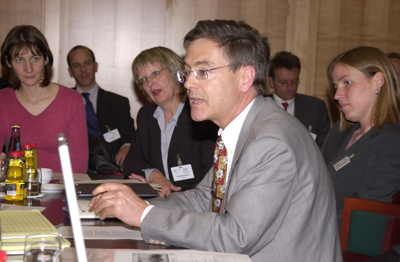 |
| German Ambassador Julius Georg Luy |
Question:
How would you describe your diplomatic experience in Burma and your relationship with government officials there?Answer: For a diplomat present-day Myanmar is an interesting and professionally challenging post. The historical, political, social and economic complexities of this multiethnic country are extraordinary and hard to decipher and understand. In the last few weeks we took up the first contacts with the new government.
Q: How has the bilateral relationship evolved since Dr. Richard von Weizsacker, the former acting president of the Federal Republic of Germany, visited Burma in February of 1986?
A: Since 1986 there has not been much of an evolution. As a reaction to the political events in Myanmar unfolding from 1988 on, EU member states reduced their relations with Myanmar considerably and introduced sanctions. It is in the hand of Myanmar’s Government to improve relations through substantial reforms.
Q: What is Germany's position on last year's election and the new government in Naypyidaw?
A: Elections in Myanmar took place under very difficult conditions. The democratic opposition and parties representing ethnic minorities were massively discriminated against. The whole process was neither free, fair nor inclusive.
However, the President’s inaugural speech of March 30 contained a number of positive statements and perspectives. Yet, at the end of the day, the government will be judged by its deeds, not its words.
Q: When Burma went to the polls on Nov. 7, there were major clashes on the Thai-Burmese border between the Burmese army and a faction of a former cease-fire group. A similar situation also occurred in Shan State more recently, and fears of renewed conflict are rising in other areas. What can the outside world do to help Burma resolve its ethnic tensions?
A: There is no simple recipe to solve the ethnic conflicts which persisted from historical Burma into present-day Myanmar. They are a challenge which at least equals and is connected to the democratic challenge. Ethnic minorities need a proper and adequate participation in the political decision-making of Myanmar. Some hopes rely on the new regional and state structures, which still have to prove their actual political impact. The clue for a solution lies within Myanmar herself, and a proper process of national reconciliation would—for all sides involved—be a good and wise way to go.
Q: On May 30, you led a delegation of German foundations meeting with Burmese government ministers and the Speaker of the Union Parliament in Naypyidaw. Burma's state-run newspapers subsequently reported that Germany agreed to assist the country's social welfare programs.



 E-MAIL
 PRINT
PRINT

 COMMENTS (8)

