
| Friday, June 17, 2011 |
As a leading member of the European Union, Germany is known among Burmese opposition groups for its soft stance towards the Burmese government and is assumed to have played a key role in relaxing EU sanctions against Burma last April. Since Burma installed a civilian government in March, there have been increasing exchanges between Germany and the new administration in Naypyidaw. Recently, Burma's state-run newspapers gave extensive coverage to meetings between Burmese senior government officials and German delegations, most of which were headed by Germany's ambassador to Burma, Julius Georg Luy.
In this exclusive interview with Irrawaddy reporter Ba Kaung, Ambassador Luy, who has been posted in Rangoon since September 2008, discusses EU sanctions on Burma, as well as the role of German companies alleged to be indirectly involved in Burma's suspicious weapon programs. He also offers his opinion of pro-democracy leader Aung San Suu Kyi.
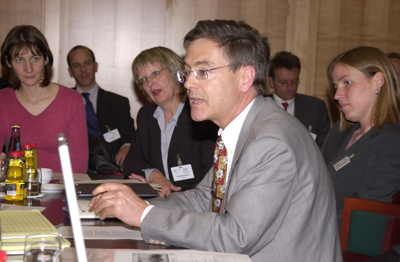 |
| German Ambassador Julius Georg Luy |
Answer: For a diplomat present-day Myanmar is an interesting and professionally challenging post. The historical, political, social and economic complexities of this multiethnic country are extraordinary and hard to decipher and understand. In the last few weeks we took up the first contacts with the new government.
Q: How has the bilateral relationship evolved since Dr. Richard von Weizsacker, the former acting president of the Federal Republic of Germany, visited Burma in February of 1986?
A: Since 1986 there has not been much of an evolution. As a reaction to the political events in Myanmar unfolding from 1988 on, EU member states reduced their relations with Myanmar considerably and introduced sanctions. It is in the hand of Myanmar’s Government to improve relations through substantial reforms.
Q: What is Germany's position on last year's election and the new government in Naypyidaw?
A: Elections in Myanmar took place under very difficult conditions. The democratic opposition and parties representing ethnic minorities were massively discriminated against. The whole process was neither free, fair nor inclusive.
However, the President’s inaugural speech of March 30 contained a number of positive statements and perspectives. Yet, at the end of the day, the government will be judged by its deeds, not its words.
Q: When Burma went to the polls on Nov. 7, there were major clashes on the Thai-Burmese border between the Burmese army and a faction of a former cease-fire group. A similar situation also occurred in Shan State more recently, and fears of renewed conflict are rising in other areas. What can the outside world do to help Burma resolve its ethnic tensions?
A: There is no simple recipe to solve the ethnic conflicts which persisted from historical Burma into present-day Myanmar. They are a challenge which at least equals and is connected to the democratic challenge. Ethnic minorities need a proper and adequate participation in the political decision-making of Myanmar. Some hopes rely on the new regional and state structures, which still have to prove their actual political impact. The clue for a solution lies within Myanmar herself, and a proper process of national reconciliation would—for all sides involved—be a good and wise way to go.
Q: On May 30, you led a delegation of German foundations meeting with Burmese government ministers and the Speaker of the Union Parliament in Naypyidaw. Burma's state-run newspapers subsequently reported that Germany agreed to assist the country's social welfare programs. Does this mean that Germany is going to resume official development cooperation with the new government in Burma?
A: It is the common position upheld by all EU member states, including Germany, that the time to resume fully fledged official development cooperation has not come yet. This is very costly for Myanmar and has tangible effects: According to UN statistics, Myanmar annually receives US $6 of economic assistance per capita, whereas neighboring Laos receives $60!
Q: In a phone call with Aung San Suu Kyi in March, German Chancellor Angela Merkel called for the release of political prisoners in Burma and on June 2, she urged the Association of Southeast Asian Nations (Asean) to openly discuss Burma's human rights issues before allowing the country to take the bloc's chairmanship. Have you ever raised these issues with Burmese government officials in the country or made any public statement about them?
A: The release of political prisoners is an important political priority of the European Union and the German government. It has been and is being raised in our meetings with all our partners in Myanmar. These and other human rights questions are central issues taken up by the German government’s Human Rights Commissioner during his talks in Myanmar last week.
Q: There have been reports that you have actively argued in closed meetings that the EU should lift its sanctions against Burma. At the same time, Chancellor Merkel is urging the Burmese government to release political prisoners. Which do you think should occur first—the release of prisoners, or the withdrawal of sanctions?
A: As I said before, the release of political prisoners is an important political priority of the German government. With regard to the second part of your question, I would like to state once more: the time to lift more sanctions has not come yet. I regret however that public discussions about how to support the Myanmar people often underestimate the wide range of instruments available in the diplomatic and foreign policy toolbox. If you read the EU’s common position you will find that it does not only contain restrictions, but also encouragement, too.
Q: Leaked US diplomatic cables show that German officials, along with those of Spain and Italy, have expressed doubts about the effectiveness of EU sanctions against Burma. What role did Germany play in the EU's decision to ease sanctions in April?
A: As a matter of principle I don’t comment on leaked confidential cables. However, Germany has substantially supported the work on the most recent decision of the Foreign Affairs Council of the EU on the common position. It is a position supported unequivocally by all EU member states.
Q: The EU has imposed an arms embargo on Burma, as well as a limited ban on trade and investment, but this hasn't prevented German weapons manufacturer Fritz Werner from continuing to do business with the Burmese military. How does this work within the framework of EU sanctions? Can you tell us more about the nature and extent of these sanctions, and why you think they are too stringent?
A: To my best knowledge, the company Fritz Werner has no arms-related business in Myanmar. Anything else would not only violate the EU’s common position and be punishable accordingly, but harm as well the business and reputation of any European company considerably.
Q: Last year Al Jazeera reported that the German firm Deckel Maho Gildemeister (DMG) sent engineers to Burma to assist with the installation of specialized imported machinery in Burmese military-owned factories. Is it true, as the report claims, that German diplomats in Rangoon visited two of those factories in 2008 and 2009?
A: DMG has delivered education-related turning machines to Myanmar. The repeated visits of experts and officials give us no indication that these machines are not being used in accordance with their assigned purpose.
Q: During President Thein Sein's recent visit to China, Burma and China said that they had established a strategic relationship. What are Germany's views on the regional and international implications of China's growing influence in Burma?
A: Myanmar seems to strive for balanced relations with the region. This includes her relations with China as well. However, trade and economic relations between Myanmar and China have increased considerably over the last few years.
Q: What do you think about Burma's relationship with North Korea, and reports that Naypyidaw has nuclear ambitions?
A: Any report on developments anywhere in the world not in line with the international obligations arising out of the Non Proliferation Treaty is taken very seriously by the international community.
Q: We have heard that the German embassy in Rangoon believes that Aung San Suu Kyi should not be singled out for meetings with EU diplomats, since such an action might offend representatives of other opposition parties. What are your views on Suu Kyi's status in relation to that of leaders of parties represented in the Parliament in Naypyidaw?
A: Germany—as like other EU member states—respects the decision of political parties to participate in last year’s elections as well as the decision of other political parties not to take part. We maintain contacts with a wide range of political actors, as well as with members of the opposition, be they inside or outside Myanmar’s new institutions. Amongst them Daw Aung San Suu Kyi is an outstanding personality giving an impressive example of self-discipline, modesty, sacrifice and an untiring search for peaceful solutions. She is and will be an inspiration for many people and has her important place in Myanmar’s political development.