
The Man Who Foresees Storms


 E-MAIL
 PRINT
PRINT

An apocalyptic series of earthquakes, cyclones, tsunamis and floods in the region has spooked everyone. Many people have turned to soothsayers and astrologers for advice about any impending natural disasters.
But rather than consult the Mayan calender or a fortune-teller, The Irrawaddy reporter Min Naing Thu interviewed Dr Tun Lwin, the former director-general of Burma's Department of Meteorology and Hydrology (DMH).
Since his resignation from the DMH in 2009, Tun Lwin has served as a technical adviser to the Regional Integrated Multi-hazard Early Warning System (RIMES) at the Asian Institute of Technology in Thailand. He also served as a consultant to the Myanmar Red Cross Society, CARE Myanmar, Action Aid Myanmar and Myanmar Egress's Network Activities Group. He has also been involved with the International Centre for Water Hazard and Risk Management (ICHARM), Myanmar Egress, World Vision Myanmar, Global Green and other organizations, focusing primarily on climate change and how to minimize damage caused by natural disasters.
Tun Lwin posts many of his articles concerning meteorological issues on his website, Myanmar Climate Change Watch.
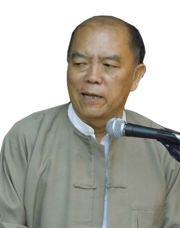 |
| U Tun Lwin |
Answer: It's very different. When I was a civil servant with the DMH, I had to follow regulations and had to seek permission or approval from my seniors before doing something. Now that I am working on my own I am free to do what I like. The main difference is freedom.
Q: What kind of references and tools do you use to predict weather conditions?
A: Basically, I use my experience combined with the meteorological knowledge I gained at Florida University. The only tool I have for my work is the Internet. Based on sources of information from various websites I predict what will happen in Burma.
Q: In a recent article, you said Burma needs radar equipment to measure and analyze rain clouds, tornadoes and tropical storms. You also said the DMH has been trying to procure the necessary tools and equipment since 1997. Why has it not happened?
A: In terms of tools and equipment, we just need a meteorological radar station [radar dish and antennae]. There are different types of radar and based on their capacity we can even see every little thing within range.
We don't have a good radar station. We used to have one in Kyaukpyu, but it was manufactured in 1974 and, I think, the radar was installed around 1976. We, the personnel at the DMH, used it frequently. However, with time it became worn out and needed to be repaired. The problem was that we couldn't find spare parts to fix it as it was an old model. Since then, we have been trying to get a new radar station. We asked the World Meteorological Organization, but it didn't transpire. We simply couldn't find any donors.
Q: How much would it cost to install a competent radar station?
A: The cost depends on what kind of radar station we are talking about. We have calculated that if we reinstall a radar dish in Kyaukpyu together with a monitoring station and staff quarters, it will cost about US $7 million.
Q: Internet users in Burma often complain about inefficient speed and service, and say that it crashes regularly. You said you use the Internet exclusively in your work to forecast meteorological conditions. How does this affect you?
A: Of course, I have found it difficult using the Internet [in Burma] as its speed is inconsistent. It makes it difficult for me to collect the information I need or to update my site. The best time to use the Internet here is when others are not using it. Sometimes I sit up all night because it has a faster connection. Sometimes, I go to high-speed Internet cafés.
1 | 2 next page »
 COMMENTS (3)
|
||
|
||
 |
|
||
|
||
 |
|
||
|
||
|
- Turning Tourism Awareness into Action
- Soldiers of Mixed Fortunes
- Exclusive Interview with KIA Vice-Chief of Staff
- 'We Have to Go For It!'
- Will the Golden Land Have a Silver Lining?
- Nine Years Sleeping on a Cold Concrete Floor
- ‘I Am Not a Bad Monk’
- Ambassador Mitchell's Press Briefing
- Rapporteur on Rights and Reforms
- ‘They Are Fighting Us Like a Foreign Invasion'