
Practice What You Preach


 E-MAIL
 PRINT
PRINT

With Burma's new parliament having completed its first session, there is now an ongoing debate as to whether the country's first legislative branch in 20 years will promote an agenda that benefits the people and where the nation's democratic transition is heading. To get a journalist's point of view on how effective the new legislature has been and will be in the future, The Irrawaddy reporter Htet Aung interviewed Wun Tha, a veteran journalist currently serving as an adviser to the editorial board of the Rangoon-based Pyithu Khit Journal. Wun Tha is a former member of parliament elected in the 1990 election for the National League for Democracy (NLD), a seat he was never allowed to occupy after the military junta rejected the election results.
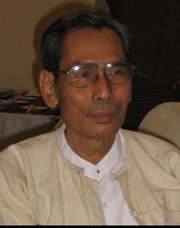 |
| Wun Tha |
Answer: Regarding the people's trust of the new parliament, it cannot be said that they support it enthusiastically. The people's voice is silent. After the obvious flaws of the election in November, the people feel discouraged and not interested in the parliament that emerged as a result of it.
But if we talk about the reality, the parliament has already had an effect by holding its sessions, electing a president and two vice-presidents, and forming a new government headed by the president. When observing all these events, I found a new government but with the same faces [as the former junta], except three or four new ones. Given that, the people say: 'Nothing has changed.' As a journalist, this is what I heard from the public.
President U Thein Sein has given several speeches to the parliament and the new government. In his speeches, he spoke about “good governance,” “clean governance,” “the rule of law,” and “anti-corruption.” As all these are the universal truths for every government, there is no point in arguing or rejecting them. As a leader of a country and its government, he must not only say all these things, but put them into practice.
Talk is fine, but where are the results? This is what the people have begun to sound out in public.
As a journalist, not only do I listen to the voice of the people, but I also write my analysis in a news journal. I wrote that I welcomed the president's speech, but I urged him to carry out what he promised as quickly as possible. As others have said, I feel it is not enough to say “Let's wait and see.” Now, it is just over a month since the new government took power. That means that it is time to talk about policies and to move forward toward the implementation level.
In my articles, I often say that the situation in this country has been deteriorating badly. Even if the government begins to reform the country, they will face many obstacles. It is because the attitudes, systems and technical procedures within the circle of the bureaucratic mechanism have long been badly degraded—not only among civil servants, but also among the general public whose morale and attitudes are now very low.
We don't need to ask why. We know how sick our society has been. I think even if the new president and his cabinet attempt to implement their promises, they will find it hard to change things overnight.
Q: The most difficult task of all for the new government is its credibility domestically and internationally. Because despite the new structure of the government, the players haven't changed. When the president request to chair Asean in 2014, Indonesia, the current chair, responded saying that Asean first wants to see tangible change in Burma. How significant is the issue of the new government's credibility?
A: To restore our country's good image in the eyes of the Asean and the world, the president needs to carry out and practice what he said. When doing so, the state can't enact reforms only with power. It must seek the cooperation of the other stakeholders and the participation of the democratic forces.
1 | 2 next page »
 COMMENTS (1)
|
||
|
||
 |
- Turning Tourism Awareness into Action
- Soldiers of Mixed Fortunes
- Exclusive Interview with KIA Vice-Chief of Staff
- 'We Have to Go For It!'
- Will the Golden Land Have a Silver Lining?
- Nine Years Sleeping on a Cold Concrete Floor
- ‘I Am Not a Bad Monk’
- Ambassador Mitchell's Press Briefing
- Rapporteur on Rights and Reforms
- ‘They Are Fighting Us Like a Foreign Invasion'