
| Thursday, May 12, 2011 |
With Burma's new parliament having completed its first session, there is now an ongoing debate as to whether the country's first legislative branch in 20 years will promote an agenda that benefits the people and where the nation's democratic transition is heading. To get a journalist's point of view on how effective the new legislature has been and will be in the future, The Irrawaddy reporter Htet Aung interviewed Wun Tha, a veteran journalist currently serving as an adviser to the editorial board of the Rangoon-based Pyithu Khit Journal. Wun Tha is a former member of parliament elected in the 1990 election for the National League for Democracy (NLD), a seat he was never allowed to occupy after the military junta rejected the election results.
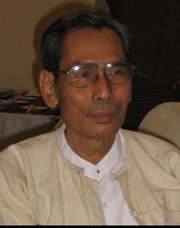 |
| Wun Tha |
Answer: Regarding the people's trust of the new parliament, it cannot be said that they support it enthusiastically. The people's voice is silent. After the obvious flaws of the election in November, the people feel discouraged and not interested in the parliament that emerged as a result of it.
But if we talk about the reality, the parliament has already had an effect by holding its sessions, electing a president and two vice-presidents, and forming a new government headed by the president. When observing all these events, I found a new government but with the same faces [as the former junta], except three or four new ones. Given that, the people say: 'Nothing has changed.' As a journalist, this is what I heard from the public.
President U Thein Sein has given several speeches to the parliament and the new government. In his speeches, he spoke about “good governance,” “clean governance,” “the rule of law,” and “anti-corruption.” As all these are the universal truths for every government, there is no point in arguing or rejecting them. As a leader of a country and its government, he must not only say all these things, but put them into practice.
Talk is fine, but where are the results? This is what the people have begun to sound out in public.
As a journalist, not only do I listen to the voice of the people, but I also write my analysis in a news journal. I wrote that I welcomed the president's speech, but I urged him to carry out what he promised as quickly as possible. As others have said, I feel it is not enough to say “Let's wait and see.” Now, it is just over a month since the new government took power. That means that it is time to talk about policies and to move forward toward the implementation level.
In my articles, I often say that the situation in this country has been deteriorating badly. Even if the government begins to reform the country, they will face many obstacles. It is because the attitudes, systems and technical procedures within the circle of the bureaucratic mechanism have long been badly degraded—not only among civil servants, but also among the general public whose morale and attitudes are now very low.
We don't need to ask why. We know how sick our society has been. I think even if the new president and his cabinet attempt to implement their promises, they will find it hard to change things overnight.
Q: The most difficult task of all for the new government is its credibility domestically and internationally. Because despite the new structure of the government, the players haven't changed. When the president request to chair Asean in 2014, Indonesia, the current chair, responded saying that Asean first wants to see tangible change in Burma. How significant is the issue of the new government's credibility?
A: To restore our country's good image in the eyes of the Asean and the world, the president needs to carry out and practice what he said. When doing so, the state can't enact reforms only with power. It must seek the cooperation of the other stakeholders and the participation of the democratic forces.
There have been some positive signs in the formation of the regional governments, especially in two or three ethnic states. Some ethnic political parties which won in the election have secured some ministerial positions in these [Arakan, Mon and Shan] state governments. This is a good image. So why can't the union government follow a similar example? According to the constitution, if someone is qualified to serve as a minister in the interests of the country, he or she can be appointed in the cabinet whether or not he or she is a member of parliament. To be frank, a kind of power-sharing should be introduced on a basis of cooperation, and all parties should consider this option.
Q: For the pro-democracy groups, the 1990 election results, which they held for so long as the ticket of political legitimacy, have all but been forgotten. Unable to accept the 2008 constitution, they decided to continue their political activities outside the parliamentary framework. Do you think this is an effective strategy? Do you think democratic groups should consider playing politics inside the official framework in the next election?
A: Politics doesn't mean that you can only act if you are in parliament. You must have room to participate in politics outside the parliament. In a democracy, there will be politics inside the parliament, politics outside the parliament, and the role of the independent politicians not associated to any party must be respected.
To shape public opinion, educated scholars, artists and writers must all have important roles in politics. However, in terms of power, those who hold it have the authority to carry out their policies.
If those in power place national interests above all else, and cooperate with the different parties, parliamentary politics will develop a relationship with the politicians outside the main arena.
In his speech, the president invited those groups which still don't believe in the constitution to come to parliament through participation in elections. His invitation is an acceptable attitude—instead of threatening that any dissent will not be tolerated. I have found that the political forces outside parliament responded to it positively as well.
Q: Since independence, Burma has had three constitutions. 2008 was the third. Previously, there were constitutions drawn up in 1947 and 1976, both of which lasted little more than a decade. Even before taking effect, the 2008 constitution was faced with strong demands for amendments. In such a situation, do you think this constitution can last long? To restore stability in Burmese politics, what do you think should be done?
A: The constitution needs to be amended. Previously, the NLD's stand was that they didn't accept the 2008 constitution at all, and wanted to hold another kind of the national convention to draw up another constitution. It could take a long time to do so. Later, the democratic groups changed their stance and demanded to amend only the parts of the constitution that are undemocratic and that the people can't generally accept. This demand sounded reasonable and fair from the side of the pro-democracy groups.
We demanded amendments to the constitution to the point that the public would accept. Responding to this demand, the president said in his first speech that if anyone wants to amend the constitution, then please come to the parliament and change it from within the parliamentary framework.
That leaves us with two choices: to change the constitution within the parliamentary framework; or to pressure the government outside the framework. In the next five years, we will see one out of the two options happen. If there are successful attempts to change the constitution within the parliament, the election in 2015 will be more inclusive, and politics at that time will be very exciting.
As we all know, there was a very limited timeframe to register political parties and candidates to contest the 2010 election. The majority were not ready to organize their party or conduct a campaign.
From now on, the political parties must prepare their party structure systematically, conducting organizational tours and finding qualified potential candidates for the 2015 election. All the parties inside and outside the country should work for a more free and fair election. If we succeed in these tasks, the 2015 election will be more inclusive and the result will provide for the betterment of the country.