|
|
|
||
|
|
|
|

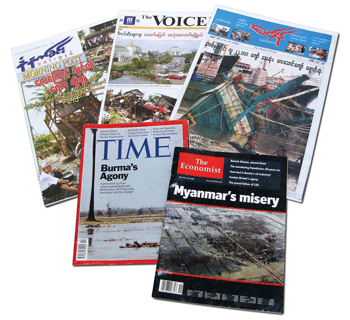
International and exiled Burmese media have played a vital role in uncovering the story behind Cyclone Nargis. But so far, no one has found a silver lining BURMA’s ruling junta has a long history of concealing disasters, both natural and man-made, so it came as no surprise when the country’s state-run media treated the aftermath of Cyclone Nargis as little more than another opportunity for the generals to show that they were firmly in control of the situation.
In the days immediately after the cyclone, official reports of its impact gave no sense of the scale of the disaster with at least 134,000 dead and missing and millions of livelihoods destroyed across the Irrawaddy delta. It did not even warrant front-page treatment in Burma. According to some Burmese media observers, the regime’s main concern was to keep its upcoming constitutional referendum foremost in people’s minds. Ironically, even if the junta had been more forthcoming, few people would have believed their reports—not because the devastation was so incredibly immense, but because Burmese people have learned to place little faith in the accuracy of official versions of events. Even as it ignored what was the biggest disaster to hit the country in generations, the regime was on high alert to stop others from taking notice. Like foreign aid workers, journalists from the international media were prevented from entering the areas hardest hit by the cyclone. Some, like BBC journalist Andrew Harding, were not even able to get into the country. Harding was deported on arrival at Rangoon International Airport for “visa violations”—or, as an official Burmese news presenter put it, possessing a “disguising tourist visa.” “Tens of thousands are dead, millions may be in need, and foreign aid workers are still waiting impatiently for visas, but the presenter put all that aside and spent several minutes solemnly describing my crimes and my expulsion,” Harding said of his experience and the subsequent coverage in Burma’s state-run media. The British journalist and author Andrew Marshall was also deported. For those who did get in, such as Dan Rivers of CNN, the experience was not merely bizarre, but frightening. After dodging the authorities for days, Rivers said he began to fear for his life. “We’re in the middle of nowhere. No one knows where we are, exactly. They could just shoot us and throw us into the river and say we had an accident,” he said. The fact that the regime had not committed the carnage Rivers witnessed in the delta hardly mattered. When his crew videotaped government workers throwing dead bodies into a river, he knew that he was dealing with a regime that was obsessed with concealing the truth. “Why should they be trying to hide a natural disaster? It’s not their fault,” he said. “It just illustrates the mentality of the regime. It’s so suspicious of the outside world.” Although Rivers went through hell and high water to come out of Burma with his story, local reporters face an even more dangerous situation. If they are caught reporting the disaster without official sanction, they won’t be deported to Thailand—they’ll be arrested and could face a lengthy sentence in Insein Prison. Whether they work for local publications or major international news outlets such as CNN or Al Jazeera, or as undercover reporters for exiled Burmese media such as the Democratic Voice of Burma or The Irrawaddy, Burmese journalists took considerable risks to report from the scene of the disaster. On May 19, eight Burmese journalists were taken into custody by soldiers and detained overnight for trying to report on the impact of the cyclone in Laputta Township, which suffered some of the worst effects of the disaster. They were released the following day after agreeing to stay away from the area. This incident may have been intended to serve as a warning to other Burmese reporters, but if so, few heeded it. 1 | 2  COMMENTS (0) COMMENTS (0)
|
  Thailand Hotels Bangkok Hotels China Hotels India Hotels
|
| Home |News |Regional |Business |Opinion |Multimedia |Special Feature |Interview |Magazine |Burmese Elections 2010 |Archives |Research |
| Copyright © 2008 Irrawaddy Publishing Group. All Rights Reserved. |


 E-MAIL
 PRINT
PRINT