
| By YENI | JUNE, 2008 - VOLUME 16 NO.6 |
International and exiled Burmese media have played a vital role in uncovering the story behind Cyclone Nargis. But so far, no one has found a silver lining
BURMA’s ruling junta has a long history of concealing disasters, both natural and man-made, so it came as no surprise when the country’s state-run media treated the aftermath of Cyclone Nargis as little more than another opportunity for the generals to show that they were firmly in control of the situation.
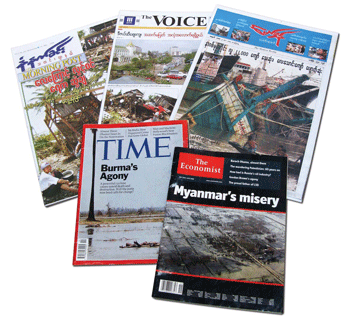 |
| Cyclone Nargis captured the attention of the world’s media. |
In the days immediately after the cyclone, official reports of its impact gave no sense of the scale of the disaster with at least 134,000 dead and missing and millions of livelihoods destroyed across the Irrawaddy delta. It did not even warrant front-page treatment in Burma. According to some Burmese media observers, the regime’s main concern was to keep its upcoming constitutional referendum foremost in people’s minds.
Ironically, even if the junta had been more forthcoming, few people would have believed their reports—not because the devastation was so incredibly immense, but because Burmese people have learned to place little faith in the accuracy of official versions of events.
Even as it ignored what was the biggest disaster to hit the country in generations, the regime was on high alert to stop others from taking notice.
Like foreign aid workers, journalists from the international media were prevented from entering the areas hardest hit by the cyclone. Some, like BBC journalist Andrew Harding, were not even able to get into the country. Harding was deported on arrival at Rangoon International Airport for “visa violations”—or, as an official Burmese news presenter put it, possessing a “disguising tourist visa.”
“Tens of thousands are dead, millions may be in need, and foreign aid workers are still waiting impatiently for visas, but the presenter put all that aside and spent several minutes solemnly describing my crimes and my expulsion,” Harding said of his experience and the subsequent coverage in Burma’s state-run media. The British journalist and author Andrew Marshall was also deported.
For those who did get in, such as Dan Rivers of CNN, the experience was not merely bizarre, but frightening. After dodging the authorities for days, Rivers said he began to fear for his life.
“We’re in the middle of nowhere. No one knows where we are, exactly. They could just shoot us and throw us into the river and say we had an accident,” he said.
The fact that the regime had not committed the carnage Rivers witnessed in the delta hardly mattered. When his crew videotaped government workers throwing dead bodies into a river, he knew that he was dealing with a regime that was obsessed with concealing the truth.
“Why should they be trying to hide a natural disaster? It’s not their fault,” he said. “It just illustrates the mentality of the regime. It’s so suspicious of the outside world.”
Although Rivers went through hell and high water to come out of Burma with his story, local reporters face an even more dangerous situation. If they are caught reporting the disaster without official sanction, they won’t be deported to Thailand—they’ll be arrested and could face a lengthy sentence in Insein Prison.
Whether they work for local publications or major international news outlets such as CNN or Al Jazeera, or as undercover reporters for exiled Burmese media such as the Democratic Voice of Burma or The Irrawaddy, Burmese journalists took considerable risks to report from the scene of the disaster.
On May 19, eight Burmese journalists were taken into custody by soldiers and detained overnight for trying to report on the impact of the cyclone in Laputta Township, which suffered some of the worst effects of the disaster. They were released the following day after agreeing to stay away from the area.
This incident may have been intended to serve as a warning to other Burmese reporters, but if so, few heeded it. Risking intimidation and braving the heavy rain and strong winds of the monsoon season, local journalists continued to play a crucial role in informing the outside world of the true situation in the delta.
They traveled to monasteries and other places of refuge to interview survivors. And they witnessed conditions that belied the junta’s claims that the emergency was over and reconstruction was ready to begin.
They were driven not only by a sense of professional duty, but also by a personal awareness of the scale of the suffering that went largely unreported inside the country. Some, including several correspondents for The Irrawaddy, saw their own homes damaged or destroyed by the cyclone.
Many were moved by the knowledge that they were seeing only a fraction of the real extent of the devastation.
“I couldn’t just sit at home watching news and mourning when I knew thousands of my fellow citizens were dead and tens of thousands more were hungry and suffering,” said Irrawaddy correspondent Kyi Wai.
Reaching the survivors in the delta is one thing; reaching readers inside Burma is another. For those journalists who work for local publications, there was the additional frustration of not being able to report most of what they witnessed.
The tightly controlled local media was under increasing pressure to print stories that made the military government appear to be in control of the relief effort, and to say the situation was returning to normal. Estimates of the cyclone death toll provided by foreign nongovernmental organizations were banned from publication.
Editors also were told not to mention the problem of international aid agencies being denied access to the delta region. The compassionate work of Buddhist monks and local relief groups was another taboo topic.
According to the official version of events, as reported in mouthpiece publications such as The New Light of Myanmar, Prime Minister Gen Thein Sein almost single-handedly managed the emergency phase of relief operations, which was declared effectively finished before international aid workers were even allowed into the delta.
When the junta’s leader, Snr-Gen Than Shwe, belatedly appeared on the scene two weeks after the cyclone hit the delta, there was, in the regime’s eyes, little left to do but hand out packages and pose for the cameras as foreign dignitaries flooded into the country to offer their assistance.
The high profile of the disaster has been an unexpected boon to the junta’s propaganda machine. Official newspapers devoted entire pages to photos and reports of C-130 aircraft landing in Rangoon with US relief supplies, as if to demonstrate that even the regime’s staunchest critic had suddenly decided that Burma’s ruling generals were eminently worthy of the world’s trust.
Of course, this didn’t mean that the regime was ready to stop portraying its detractors in a harsh light. While extolling the junta’s handling of the effects of Cyclone Nargis, the official media slammed the US government for being slow to come to the assistance of victims of Hurricane Katrina in New Orleans and attacked the VOA and BBC for their coverage.
Meanwhile, the real work of uncovering the truth about Cyclone Nargis has been left to those reporters who have already taken substantial risks to travel to the most affected areas and convey what they’ve seen and heard to the rest of the world.
“Their reporting often uncovers previously undiscovered areas of need, and they help keep the international community of donors informed of conditions on the ground,” said the New York-based Committee to Protect Journalists.
This is welcome news for Burmese journalists, who like other Burmese citizens are deeply concerned about the fate of their compatriots in the delta. But for Aung Thet Wine, The Irrawaddy’s reporter who witnessed the human cost of the disaster and shared the stories of victims with readers, the knowledge that he may be making a difference is small consolation.
After seeing the extent of the devastation in the delta and watching the government quickly declare an end to the crisis before it had even tried to meet the basic needs of cyclone victims, Aung Thet Wine thought he had seen it all, but he continued to listen to the people’s stories.
“But I still haven’t found any stories with happy endings,” he said.