|
|
|
||
|
|
|
|

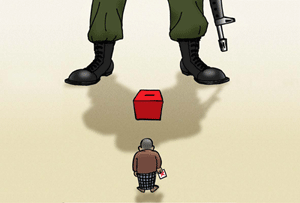
As analysts and activists debate how to respond to the regime’s draft constitution, others ask if it will cement the generals’ hold on power or trigger a popular uprising
FOR the generals who rule Burma, it is a step closer to the coveted goal of permanent military control of the country’s politics. For its detractors, it is a potential lightning rod for decades of pent-up discontent. But for most, it is still a mystery, as they wonder if this is really a distant light at the end of the tunnel or the headlights of an impending disaster. The Burmese regime’s draft constitution, which Burmese voters will be asked to endorse or reject in a referendum in May, has drawn many reactions from people both inside and outside the country. Although there is little consensus on the constitution, which was 14 years in the making, few doubt that the referendum, if it actually goes ahead, will be the junta’s most significant political move since elections in 1990, when voters unequivocally signaled a desire for an end to military rule. For dissidents in Burma, that desire has only grown stronger over the past 18 years. They see the referendum as an opportunity to let the junta and the world know that that it is time for the generals to go. “This is not a referendum,” said Tun Myint Aung, a leader of the 88 Generation Students group. “This is a chance to vote against military rule.” “The regime has given us two choices—‘yes’ or ‘no.’ But the only real choice is, should we vote ‘no’ or just boycott?” he added. Calls for a referendum boycott have been growing, but Tun Myint Aung, who spoke to The Irrawaddy by phone from a hiding place in Burma, insisted that only a vote “No” would send a clear message. “It doesn’t matter what people think of the constitution,” the prominent activist said. “They will just be voting to express the anger that has been accumulating over the past 20 years.” The Tatmadaw Chapter Of all the people The Irrawaddy has spoken to about the referendum since it was announced on February 9, few have expressed any interest in the actual contents of the constitution, which was released by the junta in March. In the absence of public debate on the constitution, most discussion among exiles and dissidents has focused on ways to effectively turn the referendum against the junta. The draft constitution does not fundamentally differ from a version of the “principles” of the constitution released by the Ministry of Information in August 2007, one month before the National Convention formally completed its work on the charter. The draft contains an entire chapter spelling out the precise powers of the military. This chapter, entitled “Tatmadaw”(Burmese for armed forces), is something new in Burma’s constitutional history and represents the first explicit attempt to enable the armed forces to “participate in the national political leadership role of the State”—one of the stated goals of the first chapter of constitutional “principles.” In concrete terms, this means that 25 percent of the seats in both the upper and lower houses of parliament would be filled with military appointees selected by the Tatmadaw commander in chief. That is, 110 members of the 440-seat lower house, or People’s Parliament, and 56 members of the 224-seat upper house, or National Parliament, would be selected from within the ranks of the armed forces. The powers of the commander in chief also extend to the selection of the president and two vice presidents. Each of these positions would be filled by individuals selected by the People’s Parliament, the National Parliament and a committee of military officials appointed by the commander in chief, ensuring that a member of the armed forces would occupy at least one of these top government positions—most likely the presidency, since the Tatmadaw exercises considerable influence over both houses of parliament. The commander in chief, meanwhile, would possess powers equal to those of the two vice presidents. While all of these measures are intended to give the military considerable power over the government, there would also be guarantees that this influence doesn’t go in both directions.  COMMENTS (0) COMMENTS (0)
|
  Thailand Hotels Bangkok Hotels China Hotels India Hotels
|
| Home |News |Regional |Business |Opinion |Multimedia |Special Feature |Interview |Magazine |Burmese Elections 2010 |Archives |Research |
| Copyright © 2008 Irrawaddy Publishing Group. All Rights Reserved. |


 E-MAIL
 PRINT
PRINT