|
|
|
||
|
|
|
|

(Page 3 of 4)
People will go their own way,” he added.
Even setting aside the question of whether the opposition would be able to alter the constitution to meet the democratic needs of the people, it remains unclear how civilians would function within a military-dominated parliament. Even the normal functions of a parliamentary opposition party could be regarded as hostile to national unity and thus subject to draconian restrictions. Another concern of the opposition is that the constitution effectively bars Aung San Suu Kyi from occupying a leadership position. As the widow of British scholar Michael Aris and mother of two sons who are British citizens, Suu Kyi would have no right to lead Burma, according to the draft constitution, which states that “the President of the Union himself [and his] parents, spouse [and] children … shall not owe allegiance to a foreign power, shall not be a subject of a foreign power or citizen of a foreign country.” Ethnic opposition groups also have cause for concern, as their claims to autonomy would also be severely constrained. As Aung Din of the US Campaign for Burma noted, ethnic state legislatures would also have military appointees occupying 25 percent of seats. “The expectations of ethnic nationalities to obtain the right of self-determination will never be realized, as unelected military officials will effectively intervene in their State affairs,” said Aung Din. “This sham constitution systematically denies equality among all ethnic nationalities and self-determination, demanded by all ethnic groups for a long time.” World Opinion Divided As Burmese debate the pros and cons of the constitution, the international community also remains divided over the junta’s latest attempt to set the terms of political change in Burma. While neighboring countries broadly support the constitutional referendum as a step forward, Western critics of the regime, particularly the United States, have dismissed it out of hand. “It has to begin somewhere and now it has a clear, definite beginning,” said the chief of the Association of Southeast Asian Nations (Asean), Surin Pitsuwan, soon after the referendum was announced. “I think it is a development in the right direction.”
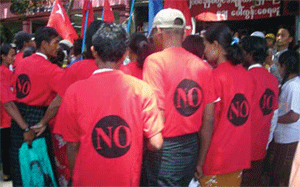
The US, which has long been the regime’s most outspoken critic, was more explicit about the shortcomings of the constitution-making process, drawing attention to the ongoing suppression of democratic rights in Burma. In a statement released after the regime declared its intention to hold a referendum, Sean McCormack, a US State Department spokesperson, said, “No referendum held under these conditions—a pervasive climate of fear in which virtually the entire population, including Aung San Suu Kyi, is under detention, and the Burmese people not being allowed to participate in or even discuss the drafting of a constitution—can be free, fair or credible.” In late February, in a move that confirmed suspicions that the junta intended to stage manage the referendum, its top leader, Snr-Gen Than Shwe, signed into effect a law that threatens dissenters with heavy penalties for opposing the referendum. Under the Referendum Law for the Approval of the Draft Constitution, anybody who publicly criticizes the referendum faces a fine and a three-year prison sentence. Thein Nyunt, a lawyer in Rangoon, remarked that the current law is even more severe than similar legislation enacted ahead of a referendum in 1973. “Under the previous law, anyone who was against the referendum could be sentenced to one year’s imprisonment. But now people can receive three years’ imprisonment under the terms of the present law.” A Final Showdown? Against this backdrop of deepening repression and a mixed international response, many activists suspect that the real referendum will take place not in the polling booths, but on the streets.  COMMENTS (0) COMMENTS (0)
|
  Thailand Hotels Bangkok Hotels China Hotels India Hotels
|
| Home |News |Regional |Business |Opinion |Multimedia |Special Feature |Interview |Magazine |Burmese Elections 2010 |Archives |Research |
| Copyright © 2008 Irrawaddy Publishing Group. All Rights Reserved. |


 E-MAIL
 PRINT
PRINT