Harn Yawnghwe is the son of Sao Shwe Thaike, who was the last hereditary ruler of the Shan principality of Yawnghwe and the first president of the Republic of the Union of Burma. He was born on April 15, 1948, four months after Burma became an independent nation. After receiving his early education in Burma, he studied in Thailand and then Canada, where he earned a bachelor’s degree and an MBA from McGill University.
Through the years, Harn Yawnghwe has faithfully served Burma’s pro-democracy movement in a variety of capacities. He was editor of Burma Alert, a monthly news digest; advisor to Dr. Sein Win, prime minister of the National Coalition Government of the Union of Burma (NCGUB), which claims to be Burma’s government in exile; and managing director of the Democratic Voice of Burma (DVB), which makes daily news broadcasts to Burma in Burmese and seven ethnic languages.
In February 1997, Harn Yawnghwe became director of the Euro-Burma Office in Brussels, Belgium. This joint project between the European Union and the German Friedrich Ebert Foundation was created to help the Burmese democracy movement prepare for a transition to a democratic government.
The Irrawaddy recently spoke with Harn Yawnghwe in an on-line interview about the current political environment in Burma, the status of reforms, the appropriate response of the international community to changes taking place in the country and ongoing challenges faced by the stakeholders.
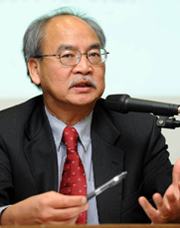 |
| Harn Yawnghwe. (Photo: Shan Herald Agency for News) |
Question:
There have been reports suggesting that within Burma’s government and military there are reform-minded and hard-line factions who are at loggerheads, what is your assessment of the situation? Do you think that reformists are gaining ground? Or are the two groups just playing a game of good cop/bad cop with the opposition and international community?Answer: It is not a clear cut case of reformed-minded liberals against hard-liners. The situation may appear that way when analyzed through a theoretical framework. That is why in 2004, Gen Khin Nyunt was seen as a liberal by some analysts. It is also not a case of good cop/bad cop. We should not fool ourselves, the Tatmadaw (Burmese armed forces) does not really care about either the opposition or the international community. Gen Ne Win seized power in 1962 because the Tatmadaw believed that U Nu was losing control. When Ne Win lost control in 1988, the Tatmadaw seized power again.
The key concept is that someone (the Tatmadaw) must always be in control to protect Burma’s independence, sovereignty and national unity. The Seven-step Roadmap was supposed to bring in a strong government with a strong Tatmadaw on standby. To protect himself, Snr-Gen Than Shwe deviated from the script and handed over power to a weak party, a weak president, a weak vice-president, a weak Parliament and a weak Tatmadaw. As a retired senior general, President Thein Sein could not let this situation persist. He had to exert control and he chose to do so through the framework of the 2008 Constitution. The disagreements we are seeing are not ideological. They are personal, because some of the others do not like the idea of U Thein Sein being the supremo. They want to be the supremo themselves.
Having a strong government that can exert control is not a bad thing in itself. All governments, even democratic ones like the US, have to be in control. Otherwise, there would be anarchy. The question is how does one decide who will be in control and how is that control exercised? If it is through the popular will, the rule of law and persuasion, it is perfectly acceptable. But if it is through the force of arms, it is not acceptable. Therefore, while some people may question President U Thein Sein’s legitimacy, the methods he is using are quite acceptable.
The other difference is that unlike Snr-Gen Than Shwe, U Thein Sein seems to be aware that for Burma to survive as a nation in the modern world, urgent reforms are needed. He is not a liberal, but he wants to make sure that his government is in control and able to protect Burma’s interests (against other nations and big business).
Will his reforms succeed? That is still an open question.



 E-MAIL
 PRINT
PRINT

 COMMENTS (14)

