Dr. Aye Maung, the chairman of the Rakhine Nationals Development Party (RNDP) was nominated last week onto the vice-presidential shortlist in the Upper House, or Amyotha Hluttaw. However, in voting on Thursday, he lost out to Sai Mauk Kham of the Union Solidarity and Development Party (USDP).
The RNDP won 35 of the 44 seats it contested in the November general election, making it the highest represented non-military party in the new Parliament.
In the wake of the vice-presidential nomination, The Irrawaddy reporter Min Naing Thu interviewed Aye Maung, and spoke to him about the role of ethnic nationalities in the new Parliament.
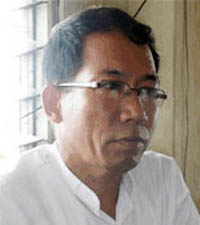 |
| Doctor Aye Maung (Photo - Narija) |
Question:
Please break down for us what happened in the voting for Vice-Presidents in the Parliament.Answer: In the Amyotha Hluttaw [Upper House], the USDP candidate was chosen by a large majority. I got 27 votes and the USDP candidate got 140. It was a similar story in the Pyithu Hluttaw [Lower House] where I heard that Saw Thein Aung from the Phalon-Sawaw Democratic Party got just 40 votes while the rest were given to Thein Sein, the prime minister in the outgoing military regime.
Q: one of the criteria for eligibility as Vice President was regarding 'vision' on military affairs. Were you questioned about this?
A: There are certain conditions for the election of Vice-President. One point in the 2008 Constitution states that the Vice-President must have 'vision' with regard to military affairs. We, the two civilian nominees, were considered eligible in this regard. However, we were not asked anything about this. I think about seven members of the electoral college briefly checked our biographies. We were asked to sit in a separate room. We chatted with the electoral college for a bit, that's all. I think it was a fair competition. The USDP has majority in the parliament and we, the pro-democracy parties, only have about 30 seats. So, it was free and fair.
Q: So, you didn't even have to answer a single question yesterday?
A: Correct. I didn't have to answer any questions. I think the electoral college already had all my personal data.
Q: How do you feel about the role of ethnic MPs in the new Parliament?
A: We understand that the doors were shut to us for the positions of chairmen and vice-chairmen in both houses, and that they would go to the USDP. However, union-level institutions such as the Union Court of Law and other tribunals will be formed soon and there will be a need to let people from various ethnic organizations and parties to be part of those institutions.
I don't mean ethnic people from a large political party being involved in those institutions. As you know, there were many ethnic people in the then ruling Burma Socialist Programme Party. To be a transparent and an internationally accepted government, it should include representatives from other ethnic parties. I think it is narrow-minded if we only trust people from our own party. What I am trying to say is: fairness, transparency and freedom, and that the majority respect the minority. I want the majority to pay serious attention to the objectives of the minority and not to reject them.
We, the pro-democracy forces, want our country to be developed and peaceful. We believe that our country will develop only after peace prevails. So, our country must be peaceful. We must completely stop the conflicts. Finally, we have to work hard for the release of all political prisoners. We want to see a situation in our country that everybody can accept. This is our wish.
Q: After the election, some ethnic parties said they wanted an ethnic Vice-President. Now, Sai Mauk Kham, an ethnic Shan from the USDP, has been chosen to fill this position. Can you say your wish is fulfilled?
A: What we see is that there can be various ethnic people involved in a large political party, but what we are trying to say is that it would be better if different views are taken into consideration.



 E-MAIL
 PRINT
PRINT

 COMMENTS (8)

