ADVERTISE | DONATION
Irrawaddy CONTACT US|FAQ
BURMESE VERSION | VIDEO


A Day to Remember
By KYAW ZWA MOE Saturday, May 21, 2005


COMMENTS (0)
RECOMMEND (436)
FACEBOOK
TWITTER
 
MORE
E-MAIL
PRINT
(Page 2 of 5)

She served four years and now lives in exile, a woman of 75 with diminishing hope of seeing democracy in Burma in her lifetime.


The junta completely ignored the election result, and continues to live in fear of exercising this most basic display of democracy. In the 15 years since the election, Burma should have gone to the polls a further three times. Theoretically, however, the parliament elected in 1990 should now be in session, its members sitting as free men and women instead of languishing in jail or living in exile. A truly representative government should be ruling Burma in place of the self-appointed, self-serving dictators now in charge.


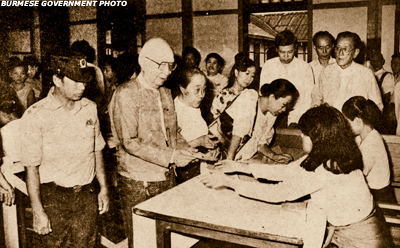
Ba Htay (left), chairman of the election commission


“The ‘wrong’ party won, that’s why the regime changed their minds about everything after the election,” concluded Burma expert Bertil Lintner. “If the NUP had won, I’m sure a new government would have been formed within days.”


Amyotheryei Win Naing, a leader of the Rangoon-based National Politicians Group (Myanmar), believes that if the election had been less clear-cut the junta would not have worried too much about handing over power to a coalition of parties and reaching a compromise with democratic forces. After all, 93 parties contested the election and the regime had no reason to anticipate such an overwhelming victory by the NLD. But the NLD landslide victory had fuelled fears within the regime that if they gave up power they might face trial for human rights abuses.


The paranoia was so intense that one senior NLD leader, Kyi Maung, was jailed for actually rejecting that possibility by bringing up the precedent of the Nuremberg war crimes tribunal. “Here in Burma we do not need any Nuremberg-style tribunal,” he said—and found himself behind bars for the indiscretion.


It is believed the junta anticipated that in the election, the NLD definitely wouldn’t win by a landslide but votes would be shared by 93 parties contesting the election, including the National Unity Party, or they might have supposed the NUP would win.


There has been much discussion—and much disingenuous talk—about the intended purpose of the election. Indisputable in this debate, however, is the fact that, in June 1989, the junta, then known as the State Law and Order Restoration Council, enacted a law to hold free and fair multi-party elections for Pyithu Hluttaw (parliament) representatives. The law clearly stated that the parliament would consist of the winning candidates in the general election.


  1  |  2  |  3 | 4 | 5 


COMMENTS (0)
 
Please read our policy before you post comments. Click here
Name:
E-mail:   (Your e-mail will not be published.)
Comment:
You have characters left.
Word Verification: captcha Type the characters you see in the picture.
 

More Articles in This Section

bullet The Mechanics of Manipulation

bullet Those Shadowy Advance Votes

bullet Locked In, Locked Out

bullet Hope on the Horizon?

bullet A Foregone Conclusion

bullet Stranded in Midstream

bullet Avoiding Details Like the Devil

bullet Business as Usual

bullet Boom or Bust?

bullet Mr. Beard Breaks Away


Thailand Hotels
Bangkok Hotels
China Hotels
India Hotels

Donations

Home |News |Regional |Business |Opinion |Multimedia |Special Feature |Interview |Magazine |Burmese Elections 2010 |Archives |Research
Copyright © 2008 Irrawaddy Publishing Group. All Rights Reserved.