|
|
|
||
|
|
|
|

(Page 2 of 4)
Thousands of political activists fled there after the 1988 pro-democracy uprising was brutally suppressed by regime forces.
Hundreds followed in May 2003 after regime thugs attacked opposition leader Aung San Suu Kyi and her supporters, and in another exodus before the resumption of the National Convention last August. Mae Sot, which sits on the Burmese border in The number is steadily shrinking, however, as exiled dissidents, either disillusioned by the absence of any movement within The resumption in late 2003 of ceasefire talks between the Karen National Union, or KNU, and the Burmese government, and the subsequent “informal” agreement between the two sides, prompted many exiled activists to renounce a struggle that began 56 years ago. Others gave up campaigning after watching with dismay as Karen leader Gen Bo Mya hobnobbed with Most of the disillusioned exiles living in
Six hundred Burmese exiles with UN documents left the so-called “Liberated Area” in 2004 to resettle in the
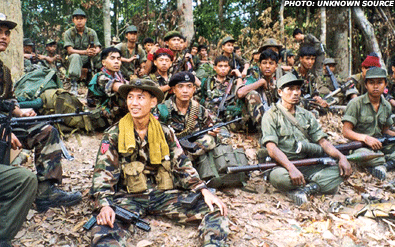
Ko Tate, Secretary of the Mae Sot-based Assistance Association for Political Prisoners, or AAPP, said 21 of the 100 or so members of his organization resettled last year in the US and Norway. The rest had applied for UN refugee status and were likely to follow. Only four or five exiles would then be left to run the AAPP office in Mae Sot, Ko Tate lamented. The Mae Sot office of the Democratic Party for a New Society, or DPNS, is in no better shape, with only about 10 of the 100 or so DPNS members expected to remain and run the party’s affairs. Also of concern to exiled Burmese activists is the shrinking strength of the armed forces of the All Burma Students’ Democratic Front, or ABSDF, founded by students who fled The “student army” grew to a formidable force of several thousand young activists, who scored some spectacular military successes against the Burma Army. But their fortunes turned in 1995 when the Burma Army captured the Manerplaw headquarters of the Karen National Union, or KNU. “The fall of Manerplaw was an immeasurable loss not only for the KNU but for the whole movement,” said ABSDF Secretary Kyaw Ko, who was among the original members of the student army. Kyaw Ko said the ABSDF strength in border areas had shrunk to about 800 from a force which he maintained once numbered in the “tens of thousands.” The ABSDF forbids its members to apply for UN refugee status, on pain of expulsion. Nevertheless, 50 members quit the movement last year in order to seek a new life in the West. “Morally and physically, this resettlement process impacts on our movement,” said Kyaw Ko. One of the DPNS secretaries, Ngwe Lin, said he understood why married exiles were seeking a new life in the West, but maintained the best location to conduct the campaign for Burmese democracy was in the “Liberated Area” of the Thai-Burma border. Kyaw Thura says most are leaving for family reasons.  COMMENTS (0) COMMENTS (0)
|
  Thailand Hotels Bangkok Hotels China Hotels India Hotels
|
| Home |News |Regional |Business |Opinion |Multimedia |Special Feature |Interview |Magazine |Burmese Elections 2010 |Archives |Research |
| Copyright © 2008 Irrawaddy Publishing Group. All Rights Reserved. |


 E-MAIL
 PRINT
PRINT