|
|
|
||
|
|
|
|

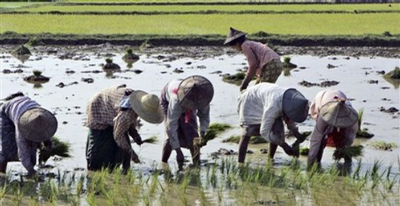
While Burma continues to count the cost of the 2008 Cyclone Nargis disaster and international aid agencies struggle to help hundreds of thousands of desperate farmers, a leading Burmese economist has called for the restoration of the country as “major rice exporter” in order to stave off poverty. At a Rangoon press conference at the weekend, U Myint, a retired UN official and a director in the board of directors of Tun Foundation Bank, said: “Higher productivity, output, incomes and employment in the rice farming sector will contribute to alleviating rural poverty and enhance greater food security at home.”
In order to increase rice exports, however, there had to be a rise in the exportable surplus of rice, U Myint cautioned. “Exportable surplus consists of current production, plus available stocks, minus projected domestic consumption,” he explained. U Myint was speaking weeks after Nobel Laureate economist Joseph Stiglitz gave an address in Naypyidaw urging the regime to invest income from gas and oil sales in the country's agricultural sector. During his visit, Stiglitz urged Burmese regime to promote access to agricultural financing, as well as to seeds and fertilizers, dramatically increase spending on health and education and create well-paid jobs in rural infrastructure in order to stimulate development and raise incomes and spending. U Myint, a frequent speaker at government-level gatherings, said revitalization of Burma's rice economy and exports was an area holding high promise for cooperation between the junta, academics, the business community, civil society organizations and development partners. “Veteran rice dealers in the country with vast knowledge and experience in the industry will survive and thrive in the competitive environment,” he said. “Others, who know little about the rice business, but who are making huge profits based on connections, cozy deals and special favors will not survive and will go out of business.” At the height of its position as the world's leading rice exporter, in the fiscal year 1938-39, Burma exported 3.3 million tons of rice, earning 46.7 percent of the country's total export receipts. Seventy years later, in the fiscal year 2007-08, Burma's rice exports were a meager 358,500 tons of rice—just 1.2 percent of total world exports, U Myint said. If this percentage were calculated on value instead of volume, he added, U Myint said rice production could be boosted “through increased and proper use of modern inputs such as fertilizers, pesticides, proper water control, improved seeds, and farm mechanization. “Moreover, there is a wide range of issues related to better pricing, distribution, storage, marketing, grading, processing, taxation and organization and management of agricultural production so that farmers' incentives are not adversely affected, they get a fair reward for their efforts, and middlemen and others do not take unfair advantage of them.” Another key issue highlighted by U Myint, and one that has received major attention, is agricultural credit. Cyclone Nargis and the destruction it wrought on infrastructure, natural and man-made capital, dwellings and livelihoods had dramatized the need for credit, he said. “But the credit crunch is a countrywide problem, although its impact varies from region to region, from township to township, and even within a township,” he added. 1 | 2  COMMENTS (2) COMMENTS (2)
|
  Thailand Hotels Bangkok Hotels China Hotels India Hotels
|
| Home |News |Regional |Business |Opinion |Multimedia |Special Feature |Interview |Magazine |Burmese Elections 2010 |Archives |Research |
| Copyright © 2008 Irrawaddy Publishing Group. All Rights Reserved. |


 E-MAIL
 PRINT
PRINT