|
|
|
||
|
|
|
|

Burmese professionals earn good money in Singapore but still miss home I feel I am nothing,” said Bo Bo Win—a statement that’s hard to believe in view of his successful life in Singapore.
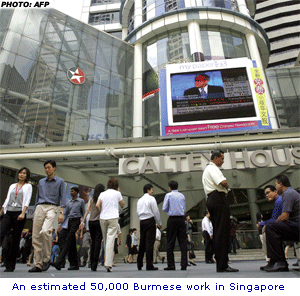
Although he holds down a well-paid job as a senior engineer, with degrees from Burma’s best technical university and Singapore’s National University, Bo Bo Win is not a happy man. “It’s so sad that we cannot contribute to the country where we were born and were first educated,” he says. “There’s nothing here.” Bo Bo Win, who is in his thirties, is one of an estimated 50,000 Burmese working in the city-state, most of them educated and skilled people who have joined a brain drain that puts additional strains on Burma’s weak economy. The loss of so many young professionals also weakens the country’s middle class, which is best equipped to help reduce poverty and strengthen the economy. Yet the flight of these educated migrants is a direct result of Burma’s deep economic, social and political crisis, which has progressively worsened since the military took over in 1962. The flow of Burmese to Singapore began in the mid-1980s, and today the city-state tops the list of Southeast Asian labor markets sought out by Burma’s young professionals wanting a better life. While about 2 million Burmese are employed in unskilled, manual work in Thailand and Malaysia, most of Singapore’s migrant workers from Burma are skilled and qualified. According to Bo Bo Win, most Burmese professionals in Singapore now hold down jobs as engineers, accountants, geologists and nurses, almost all of them with legal status. The lure of high salaries is Singapore’s chief attraction for educated Burmese. Ko Sai is a geologist, earning 1,800 Singapore dollars (US $1,170) per month, astronomically higher than the 50,000 kyat ($38) he made in Burma. He says he knows some Burmese professionals earning up to 10,000 Singapore dollars ($6,520). “Living here is satisfactory,” Ko Sai says. Burmese immigrant workers benefit from Singapore’s manpower shortage—and from the incentives offered by its government. They include the offer of permanent resident status, which brings workers employment benefits and allows them to be joined by dependents. A Singaporean diplomat said: “Burmese people have potential, and we welcome them.” The Singapore government also offers a loan covering 80 percent of further education fees. In return, recipients have to work for the Singapore government for three years after completing their studies. Hundreds of Burmese students are enrolled at the National University of Singapore, Nanyang Technological University and other colleges. Aung Naing is typical of young Burmese who take advantage of the Singapore scheme. He was admitted by the National University of Singapore for further study after gaining a master’s degree in environmental engineering management in Bangkok, and is now employed as a project officer at Nangyang Technological University. Permanent residency also qualifies Burmese immigrant workers to apply for Singapore citizenship, although the possibility doesn’t appear to attract many. “You lose your culture by living here,” says Bo Bo Win, who won’t be applying for Singapore citizenship. “I get that feeling when I see how my son is growing up.” Ko Sai says Burmese professionals in Singapore are caught in a dilemma. “The Burmese here are running away from their homeland because they hate their own country,” he says. “It’s a kind of torture for me, working here. I should be working for my country. We need to get involved in changing the system there.” Aung Naing sums up the feeling of many when he says: “I love my country, and life here has no future. But nothing is certain in Burma.” Would he and the others consider returning to Burma? They answer in unison: “Yes. But not yet.”  COMMENTS (0) COMMENTS (0)
|
  Thailand Hotels Bangkok Hotels China Hotels India Hotels
|
| Home |News |Regional |Business |Opinion |Multimedia |Special Feature |Interview |Magazine |Burmese Elections 2010 |Archives |Research |
| Copyright © 2008 Irrawaddy Publishing Group. All Rights Reserved. |


 E-MAIL
 PRINT
PRINT