
| By KYAW ZWA MOE | OCTOBER, 2006 - VOLUME 14 NO.10 |
Former political prisoners struggle to adjust to life on the outside
Disbelief is the reaction Zaw Win gets when he says: “The pressures of life outside jail are greater than those within.” The 36-year-old former student activist was freed in 1999 after serving more than eight years as a “guest” of the military junta, but life in the real world has proved as difficult—though in other ways—as his existence behind bars.
“Prison is awful,” he concedes. “But the only problems we had to deal with there were basically the authority and the lack of freedom.”
Disappointment hit the former political prisoner from the day of his release from Thayet prison, Magwe Division. His uncle greeted him with the words: “You spat from above and it just fell on your face. Stop the nonsense, stop what you’ve been doing.”
The words were not only a “very disturbing greeting,” said Zaw Win, “but a big insult to my political beliefs.” His anger was tempered by the recognition that his family and friends didn’t want him to end up in jail again because of his political views.
Pressure to keep silent and out of further trouble was only the start, however. The problems began to pile up—at home, in his search for employment, in his efforts to readapt to society and in his dealings with the authorities.
Zaw Win’s experience isn’t unique. Most of the thousands of political activists imprisoned after the 1988 uprising, initiated by students, have experienced difficulties readjusting to life outside prison, according to the Thailand-based advocacy group Assistance Association for Political Prisoners (
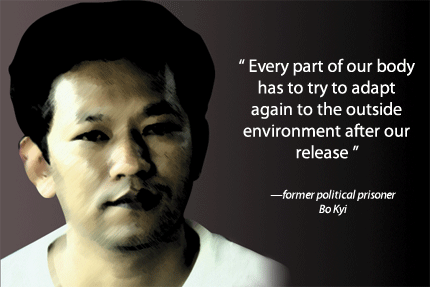
The AAPP’s joint secretary, Bo Kyi, can vouch personally for the organization’s conclusion. He is a former political prisoner and knows the problems of readjustment first-hand. “Every part of our body has to try to adapt again to the outside environment after our release,” he says.
Such subtle factors as changes of color and sound hit the released prisoner, he says. White and khaki are the colors of prison life. Freed prisoners are often unprepared for the sudden burst of color that greets them in the outside world.
Bo Kyi and Zaw Win agree that the greatest pressure comes first of all from family members, who urge the former political prisoners not to risk further imprisonment. Their concern isn’t entirely selfless—the strains of maintaining contact with their jailed relatives and keeping them supplied with items to make life in prison bearable are not to be overlooked.
Zaw Win says his parents tell him they won’t be able to supply him if he is imprisoned again. “It’s understandable because it doesn’t take a day but many years,” he reasons. “For eight years, my family supported me and supplied me with everything I needed while in jail.”
Years of imprisonment put further strain on family relationships. Partnerships and marriages break up, adding to the strains placed on released prisoners, many of whom seek solace in alcohol.
Zaw Win—like many others—is caught between his commitment to his family and his political calling. “On the one hand, we haven’t finished our mission to restore democracy to our country. That’s what I want to continue devoting my life to. But family pressure is making me turn away from politics.”
The second challenge for Zaw Win was to find a job. The search lasted 18 months, handicapped by the reluctance of employers to attract the attention of the authorities by employing a former political prisoner. For many jobs, applicants have to indicate on official forms whether they are former political prisoners.
Bo Kyi found a job in a photocopying shop shortly after his release in 1993, but military intelligence pressured his employer to let him go. Zaw Win was also harassed by military intelligence officers, who regularly called at his home and questioned him about his activities. He says he often considered leaving home to escape the harassment.
Some former prisoners are literally hounded to death. Tin Tin Nyo, a young woman student activist, committed suicide in December 1993, shortly after completing a three year prison term.
Kyaw Thike, a 43-year-old former student activist, died in August 2005 after suffering severe depression and tuberculosis, conditions said to have been brought on by his inability to readjust to life outside prison. During his time in jail Kyaw Thike was tortured and suffered hand injuries.
Many former student activists whose studies were interrupted by their arrest and imprisonment have difficulty resuming academic work, although correspondence courses are open to most of them.
Blocking the professional advancement of troublesome students is nothing new in
“That changed my life,” said 53 year-old Khun Saing, who settled in the Thai-Burmese border area early this year. “That’s one of the factors that makes former political prisoners depressed since they can’t continue their intended career.”
In a practical effort to help released prisoners, the AAPP published a handbook in August 2005, taken from a larger publication, Counselling Torture Survivors, by Allan and Mia Staehr for the International Rehabilitation Council for Torture Victims, in
Bo Kyi, who translated part of the book, said the publication would help former political prisoners, their families and society in general, confront the problems faced by released political prisoners.
But the problem is really much larger, according to Bo Kyi. “