
| By KYAW ZWA MOE | Tuesday, October 10, 2006 |
Burma’s military government resumed on Tuesday its 13-year-long National Convention, tasked with drafting a constitution, without the participation of the country’s main opposition groups, as hundreds of people in cities across the country joined a new campaign in support of detained former student leaders.
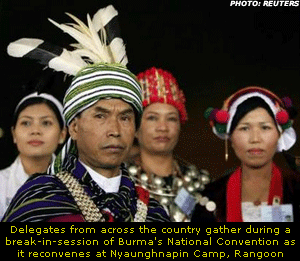 State-run newspapers earlier reported that more than 1,000 delegates would attend the National Convention, which first convened in 1993. The convention is the first of seven steps in the military government’s roadmap to democracy. No timetable has yet been given for proposed democratic reforms.
Opposition groups inside and outside the country have strongly condemned the convention. “It is valueless, since it lacks democratic principles,” said Nyan Win, a spokesperson for Burma’s main opposition party, the National League for Democracy.
The NLD won a landslide victory following elections in 1990, but the ruling junta refused to honor the results. The party’s involvement in the convention ended in 1995, when their delegates walked out in protest. The NLD reiterated its opposition to the convention in 2004, prompting the Shan Nationalities League for Democracy, Burma’s largest ethnic political party, to abandon the convention that year.
“Restarting the sham National Convention, in defiance of the UN and the people of Burma, will do nothing to solve Burma’s problems,” said Aung Din, policy director for the US Campaign for Burma. “The Burmese people want real democracy, not a wolf in sheep’s clothing.”
Meanwhile, sources in Rangoon and Mandalay said that hundreds of people have participated in a new campaign called “White Expression” by wearing all white clothing. The campaign was launched on Tuesday by the 88 Generation Students group and will run until October 18.
The campaign is intended to push the military government to free all political prisoners and initiate a genuine national reconciliation process. The group, which is composed of former political prisoners, planned its campaign a few days after authorities arrested its five leaders—including the most prominent leader, Min Ko Naing—at the end of September.
Nyan Win said that all members of the NLD wore white clothing on Tuesday. Well-known Burmese comedian Zarganar added that many young people could be seen wearing white in downtown Rangoon, particularly in shopping malls. “I have seen many young people wearing white since this morning,” Zarganar told The Irrawaddy on Tuesday. “I am also wearing white.”
Tin Win Yi, an NLD member from Mandalay, said that many people there were also joining the campaign.
Prior to the White Expression campaign, the student group began a petition campaign to free their detained leaders. Nyan Win said that two of its youth members were arrested last week after collecting signatures and trying to send them to the student group.
Win Ko, a youth leader, and Than Win, both from the Moe Nyo township NLD office, were arrested at a train station in their township while carrying petition signatures to the 88 Generation Students group.
As of Saturday, some 120,000 signatures have been collected, according to the student group.
| The National Convention Line-up Following is a list of the political parties and ethnic ceasefire groups attending the current session of Burma’s National Convention: 1. Kokang Democracy and Unity Party 2. Union Kayin (Karen) League 3. Union Pa-O National Organization 4. Mro (aka) Khami National Solidarity Organization 5. Lahu National Development Party 6. Wa National Development Party 7. National Unity Party: a political party formed by the military junta and members of the Burma Socialist Program Party led by the late dictator Ne Win. It won 10 seats in the 1990 election. 8. Myanmar National Democracy Alliance Army (Kokang): the MNDAA signed a ceasefire agreement with the regime on March 21, 1989. Its leader is Phone Kyar Shin. The group commands control of Special Region-1, northern Shan State. 9. United Wa State Army: formerly called the Myanmar National Solidarity Party, the UWSA signed a ceasefire agreement with the regime on May 9, 1989. Its leaders are Bao Yuxiang and Kyauk Nyi Lai. The group controls Special Region-2, Shan State. 10. Shan State Army (Shan State Progress Party): the SSA, commanded by Col Loi Mao, signed a ceasefire agreement with the military government on September 2, 1989. It is based in Special Region-3, Shan State. 11. National Democratic Alliance Army (Shan/ Akha Armed National Groups): the NDAA, led by Sai Lin and Lin Ming Xian, signed a ceasefire agreement with the military government on June 30, 1989. It controls Special Region-4, eastern Shan State. 12. Kachin Defense Army: founded in 1990 by Mahtu Naw, commander of the Kachin Independence Army’s 4th brigade, northern Shan State, the KDA broke away from the Kachin Independence Army in the same year and signed a ceasefire agreement with the regime on January 13, 1991. It is now based in Kawng Ha and controls Special Region-5, northern Shan State. 13. Pa-O National Organization: the PNO, led by Aung Kham Hti, signed a ceasefire agreement with the junta on April 11, 1991. The group controls Special Region-6, southern Shan State. 14. New Democratic Army-Kachin: the NDA-K, founded by Zahkung Ting Ying, its current chairman, signed a ceasefire agreement with the junta on December 15, 1989, the year in which the Communist Party of Burma collapsed. It’s based in Pang Wa, on the Sino-Burma border, controlling the Kachin State Special Region-1. 15. Kachin Independence Organization: Founded on February 5, 1961, by Zau Seng , the KIO signed a ceasefire agreement with the military government in February, 1994. Currently led by Lanyaw Zawng Hra, the KIO is the biggest Kachin armed group, based in Laiza, on the China-Burma border, in Special Region-2. 16. Kayan National Guard: the KNG, led by Gabriel Byan and Htay Ko, signed a ceasefire agreement with the Burmese military government on February 27, 1992. It controls Special Region-1 Kayah (Karenni) State. 17. Karenni State Nationalities Peoples Liberation Front: the KNPLF, led by Sandar and Htun Kyaw, signed a ceasefire agreement with the junta on May 9, 1994. The group controls Special Region-2, Kayah (Karenni) State. 18. Kayan New Land Party: the KNLP, led by Shwe Aye, signed a ceasefire agreement with the regime on July 26, 1994. The group controls Special Region-3, Kayah (Karenni) State. 19. Karenni National Democratic Party: the KNDP (Naga), a group of the Karenni National Progressive Party that signed a ceasefire agreement with the military government in 1995, but which broke the ceasefire a few months later. Its leader, Lee Rey, remained in Rangoon, and in 1996 he organized the KNDP. Also named the Karenni National Defence Army, it’s based in Kayah (Karenni) State. 20. Karenni National Progressive Party (aka Hoya): the KNPP (Hoya), led by Ko Ree, signed a ceasefire with the junta in October, 2003. The group broke away from the KNPP at that time. 21. Karenni National Solidarity Organization: the KNSO (Ka-Ma-Sa-Nya) broke away from the KNPP at the same time as the KNPP (Hoya), and then signed a ceasefire agreement with the junta in 2003. It’s led by a commander Richard, (aka) Ka Ree Htoo. 22. Democratic Karen Buddhist Army: the DKBA broke away from the KNU in 1995 and signed a ceasefire agreement with the military government. The group is led by a monk, U Thuzana. 23. Haungthayaw Special Region Group: the HSRG, led by Tha Mu Hei, surrendered to the military government in 1997. Tha Mu Hei Battalion 16 of the KNU’s Sixth Brigade. 24. Nyeinchanyay Myothit: this group, which also calls itself the Phayagon Special Region Group, surrendered to the military government in 1998, together with about 40 students led by Padoh Aung San, of the KNU. It is based in Hpa-an, Karen State. 25. Burma Communist Party (Rakhine State Group): led by Saw Tun Oo, this group surrendered to the military government on April 6, 1997. It controls an area of Arakan State. The group also names itself the Rakhine State All National Races Solidarity Party. 26. Mong Tai Army (Shwepyiaye): the MTA signed a ceasefire agreement with the military government on January 5, 1996. It is led by Khun Sa and controls the area of Homong, southern Shan State. 27. Homong Region Development and Welfare Group: located in southern Shan State, east of the Salween River, this group is led by an ethnic Wa, Maha Ja, owner of Shan State South Co Ltd, or the SSS Company. 28. Manpan People’s Militia Group: this group is based in Tangyan, southern Shan State, and its operational areas extend to the Salween in the east. Its leader is Bo Mon (aka U Sai Mon), veteran former associate of drug lord Khun Sa. He is said to have enjoyed the trust of the junta, and was awarded an “Outstanding Social Service Prize” for banning poppy cultivation in his operational areas during the 2005-2006 poppy season. 29. Arakan Army: this group broke away from the exiled Arakan Liberation Party. Its founder, Khai Ya Zar, died in custody in India after being arrested there in the late 1990s. The AA delegation attending the National Convention is reportedly only a nominal one. 30. Mon Peace Group (Chaungchi Region) 31. Mon Nai Seik Chan group |