
| Tuesday, September 27, 2011 |
On Monday, around 200 protesters peacefully marched in downtown Rangoon to mark the fourth anniversary of the Saffron Revolution. Naw Ohn Hla, a leading female activist who in the past took part in Tuesday gatherings at Shwedagon Pagoda to pray for the release of Aung San Suu Kyi, and who continues to pray for political prisoners still behind bars, was one of the organizers of this rare public commemoration of the events of September 2007, when the Burmese authorities violently cracked down on Buddhist monks.
Irrawaddy reporter Saw Yan Naing spoke to Naw Ohn Hla about the police reaction to the protest, and why she decided to launch it.
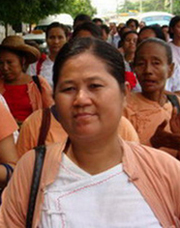 |
| Naw Ohn Hla |
Answer: We marched peacefully with the aim of marking the fourth anniversary of the 2007 Saffron Revolution. We chanted the Metta Sutta [the Buddhist discourse on loving-kindness] and some of us wore yellow shirts in memory of the Buddhist monks who died in the Saffron Revolution.
There were three messages written on the yellow shirts: “2007 Saffron Revolution: May the cause of the people prevail”; “Wake up, people of the Irrawaddy”; and “Release all political prisoners immediately without condition.”
Q: Did anyone ask you to hold this protest, or did you initiate on your own?
A: I initiated it myself with the participation of members of my family, relatives of political prisoners, and some members of the 88 Generation Students group, as well as other activists from five townships in Rangoon. I think there were several hundred people.
Q: Was there any disturbance or crackdown?
A: Three vehicles that carried us were stopped by the police near Nawaday intersection. We told them that we would have walk if they didn't allow our vehicles to pass. So we got out and and started marching. They tried to stop us. They told us that they could take action against us if we gathered in a group of more than five people. But we told them that we had the right to walk freely, and that according to the Constitution, people can assemble and march peacefully without weapons. But they said that the Constitution hadn’t come into effect yet. We ended the protest peacefully at around 2 pm.
Q: Did you inform authorities in advance about your plans to mark the anniversary?
A: No, we didn’t inform them. We just called each other by phone and gathered together.
Q: Some say that launching such a protest now could damage the efforts of Aung San Suu Kyi and President Thein Sein to achieve some sort of rapprochement. What do you say to this?
A: I don’t think so. Daw Aung San Suu Kyi and U Thein Sein are doing their work for the sake of the country, and we are also doing what we can and should do. This is our contribution to our country. It doesn’t damage their work.
Q: You actively campaigned for the release of Aung San Suu Kyi in the past and you are still campaigning for the release of political prisoners. What makes you want to do this?
A: Yes, I campaigned and prayed for the release of Daw Aung San Suu Kyi. And not only her, but also for other political prisoners. The government says there are no political prisoners, but only criminal prisoners, so I want to highlight the fact that there are political prisoners in Burma. I will continue my campaign until all of them are free.