
| By ZARNI MANN | Thursday, June 9, 2011 |
After more than 13 years detained in prisons in Kolkata and Port Blair, 31 of the 34 Burmese rebels were freed on May 19. The remaining three face further questioning and investigation in Port Blair.
One of the released, Karen National Union (KNU) member Saw Kayti, spoke to The Irrawaddy recently about their arduous journey to the Andaman Islands where they were captured by the Indian Navy and sentenced to life imprisonment on terrorism-related charges.
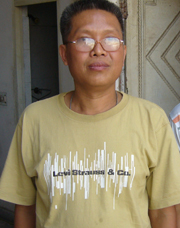 |
| Saw Kayti |
Answer: one day, he came and told me we have to do a joint operation at sea with the army of the National United Party of Arakan (NUPA) led by Khine Yarzar. I had to go along as I can speak Thai well, and I could help in communicating with the boatmen. He did not tell me details. He popped up one day while I was taking care of my sick father and said it was time to go. That was in October 1997.
From there, Padoh Moo Lwae, Cha Lwae and I arrived in Kanchanaburi [a city in western Thailand] and went to Ranong [a Thai town on the Burmese border]. Our other comrades arrived later. From there, we crossed the sea to a small island named Myauk Nyo where our Battalion 11 was located. We met with Soe Naing and four or five soldiers from the Arakanese army.
At that time, we did not know that we’d have to go to India. In February 1998, Khine Yarzar met us there. My brother said Khine Yarzar, who was in contact with the Indian intelligence services, had been promised an island in India. There, we could launch coordinated Arakan-Karen operations against the Burmese government and train recruits. Khine Yarzar later went back to Arakan. That's all I knew about it.
The journey was tough. On February 9, 1998, we reached Narcondam Island. At the time, we didn't even know the name of the island we had reached. We found out later while we were detained.
Q: How did you manage to make contact with the Indians?
A: We spent one night near Narcondam Island, and made contact with them next morning.
First, Khine Yarzar, Padoh Moo Lwae and some privates went into the bay. We had to wait on the boat until we got the message that we could come in. In the evening around 4, we reached Landfall Island. We found out Landfall Island’s name later in detention. It was in Indian territory—a lot of big islands. The views were very pleasant. I didn't disembark onto the island. I just stayed in the boat.
Q: Where did you meet Indian Lieutenant Colonel Grewal?
A: As soon as we reached Landfall Island, Grewal came to meet with Khine Yarzar. Khine Yarzar introduced him to all of us. He spoke Burmese very well. He asked me if I wanted to go to Arakan. I replied that I didn't know yet, and he asked me to fish for his soldiers. I asked the Thai helmsman where to find fish; however he replied he couldn't do that at the time. On next day, the helmsman found a place to fish. At any rate, Grewal said it was okay and went onshore.
Q: Do you have any idea of the discussion on the shore with Grewal and your leaders?
A: No, I didn't know as I was not there. I was just an underling. The Arakan soldiers also don't know. I never saw Khine Yarzar again after he went onshore with Grewal.
Q: When did the Indian Army arrest all of you?
A: I was sleeping on the boat that night. I didn't see the other boats. As the sun rose, it was February 11, I saw one navy ship in the distance. Around five minutes later, I heard from my wireless radio saying clearly in Burmese: “What is that in the front, what it is? Report, if there is anything strange!” I then thought we must be in Burmese waters or I would not have heard Burmese words. On our boat, there was a fisherman from Burma who worked in Burmese army for many years. He told us that these words are used in the army, not by civilians.
I asked the Thai helmsman whether we are in Burmese or Indian waters and he replied we were in Indian waters and Burmese Navy couldn't come in.
Five minutes later, Maj Saw Tun and Lt Yan Naing of the NUPA arrived on a small speedboat. I informed them I heard the Burmese Navy on my radio.
One of them—I don’t remember who—took my radio and called Soe Naing who was onshore. He said, “Soe Naing, Soe Naing, do you hear me?”
There was no reply from the other side. Then, we tried to contact Padoh Moo Lwae's radio, but no reply. Maj Saw Tun asked me to drive into the bay. As we approached the shore, we saw our people laying down on the shore and the situation there seemed unusual. They were being arrested.
Later, they arrested Major Saw Tun. They tied our hands behind our backs, covered our eyes and kicked us down to a lifeboat and took us to the shore. We couldn't see a thing as our eyes are covered. They dragged us onto the shore and forced us lie on the ground.
They dragged Maung Naing, a private, and asked him something. Since he didn't understand their language, they beat him with their guns till his ribs broke. They arrested us without saying a word.
We couldn't talk to each other. When we did, they hit us on the face. Later, they sent us to a prison in Port Blair. We didn't know it was called Port Blair at that time.
There, we did not know which date it was. One evening, Grewal came to us and told us our leaders were guilty and India already punished them. At that moment, we didn't know what he meant, and I was not sure if they killed Padoh Moo Lwae and the other leaders.
I realized we were being arrested when I heard gun shots, over 30 shots from my boat, just before they captured me. We made the connection between the incidents as our leaders disappeared and we believe that they were shot dead by the Indians.
Grewal and some officials said there was a gunfight between our leaders and the Indian military, so our leaders were shot. We don't believe that because our leaders didn't possess any weapons at the time.
I feel very sad for my leaders. But what can I do? They were good people, working for our country and for our people. For Padoh Moo Lwae [who also died], he was my brother, my teacher, my leader. I respect him and am proud of him.
Q: How did you all manage to get help and to contact lawyers?
A: A human rights lawyer named Henry came to us. At first, the authorities did not allow us to meet him. Later, they allowed Henry to meet with one person for a short time. We could do nothing. They thought that we were terrorists.
Later, a lawyer, Nandita Haksar, handled our case, and she has had to struggle much.
Q: What were your experiences while you were in Port Blair?
A: We stayed in the Port Blair prison for 20 months. They [the officials at the Port Blair prison] seemed to understand our situation a bit.
There, Danya Linn taught English to a young person in his spare time. We occasionally were visited by the Karen who had lived in Port Blair since colonial times.
Later, they put us in a three-story building like we were under house arrest. We had to cook for ourselves. We were accompanied while we went out to buy things.
The house was an old building on the brink of collapse. Luckily, some weeks before the 2004 tsunami [which took place during Saw Kayti’s detainment], we were moved to another building as the first building was not safe. During the tsunami, that three-story building collapsed. Had we not moved, we all would have died under a pile of old bricks.
As the earthquake hit the island, I was standing, was jolted, and fell on the ground. I shouted, “What happened? What happened?” Somebody shouted, “Go outside! Go outside!”
It was quite strong. So strong, we could barely stand. We crawled on all fours to get out of the building. We fell down even though we were crawling. We never experienced this kind of earthquake before. We all were swaying and felt dizzy.
Q: How did you get to Kolkata prison?
A: In Port Blair, they did not investigate our case or bring it to trial. Our lawyers told the authorities it was not worth the effort of pursuing a case against us, but the Indian authorities indicted us.
Later, our lawyer arranged to send us to Kolkata where we could be in touch with the Burmese community in New Delhi, and so that the lawyers could have easy access to us.
On arriving at Kolkata prison, the prison authorities thought that we were terrorists and treated us poorly by putting three people in a small cell meant for one person.
There, we faced many difficulties. There was no fan, and ventilation was not good in that tiny room. We could not live in that room during the hot season.
We only got small fish [their only protein source] once a week. Once, a convict overseeing us stole our fish, and an argument broke out between us and the guards. The guards ordered the prisoners to beat us. We were beaten so severely that three of us had to be hospitalized. The next day, the guards apologized.
We asked for better rooms and they gave us a big hall. There, our food rations were increased, and the food was more nutritious.
But although the prison conditions had improved, our minds were not free.
But the prisoners there started to accept us.
Q: How do you get to know you all will be free soon?
A: Our prisoner friends told us. They knew everything. The prison authorities also told us we would be freed soon. They also wanted us to be free. They were happy to hear the good news too. They said once we got refugee status from the UNHCR, the Indian government would give permission for us to stay in its territory for one year. We were overjoyed, but we took things a day at a time.
We prepared all our belongings to leave and checked them again and again. I don't remember how many times I checked my belongings.
The day I was freed, I have no words to describe. As we went through the gate, an applauding crowd welcomed us. And there were a whole bunch of cameras. My eyes were full of tears—tears of joy.
When we arrived in New Delhi, people welcomed us with garlands and shouted, praising us.
In our revolutionary world, a welcome with flowers and garlands is for those who come back from a victory in battle. They were welcoming us like celebrating a victory. I didn't know how to express my joy.
Q: Do you have contact with your family now?
A: I have no idea where my daughters are. Some rebels are in contact with their families. Some lost their parents while they were in the prison. Some are still finding their families, siblings and relatives.
Q: What is in your future?
A: I don't know what to do. I want to go back to Karen State, but we can't, as we all know. I don't know what kind of situation is waiting for us in the future. I’m also worried about our security even though I’m free now. This is not our country, and we cannot be assured of our safety yet. We just have to work for our country and our people as much as we can.
Related Article: Going Rogue in the Andaman Sea