
| Friday, May 6, 2011 |
With Burma's new Parliament having recently completed its first session, there is now an ongoing debate as to whether the country's first legislative branch in 20 years will promote an agenda that benefits the people and where the nation's democratic transition is heading. To get a first-hand account of the parliamentary session and perspective on how effective the new legislature has been and will be in the future, The Irrawaddy reporter Htet Aung interviewed Dr Myat Nyana Soe, a member of the National Democratic Force (NDF) who was elected to the Amyotha Hluttaw (Upper House) of Parliament.
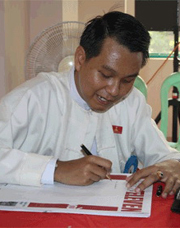 |
| Dr Myat Nyana Soe |
Answer: The parliamentary sessions lasted for two months, but it should be noted clearly that this Parliament took place during the rule of the State Peace and Development Council (SPDC). Only in the last days of the session was the new president sworn into office. There has still been no parliamentary session to be held under the new government. Therefore, the discussions on the questions and proposals happened under the rule of the SPDC and the answers were given by the SPDC ministers. Because of that, there were questions and answers that weren't clear and often derailed the points.
However, as I intended before, I was personally able to sound out the parliament on the concerns of the people. In reviewing the parliamentary sessions, I think we were able to bring the people's voice to the parliament to some extent, but how effective was it?
Let me give an example. I asked about the mobile phone system, but didn't get a clear answer from U Thein Zaw, who was then the minister of communications, posts and telegraphs. However, after the new government took power, U Thein Htun, the new minister, outlined a five-year plan for expanding mobile phone lines by up to 30 million. He said that within the first fiscal year the expansion will be about 5 million, which is more than double existing numbers. It means that the discussions in parliament didn't just evaporate into the air after the sessions. According to Article 445 of the Constitution, the new government has the obligation to continue what the SPDC and the State Law and Order Restoration Council (SLORC) [the former name of the SPDC] had done. Because of that, it can be concluded that the new government will continue to carry out what the previous government said.
Another point is that we can't say that we have been away from the parliamentary landscape for 22 years. We need to add another 26 years [of the one-party socialist system], so we haven't had such a parliamentary democratic system for nearly 50 years. Because everybody is at the stage of just testing the water at this time, there have been some questions that only focused on a region and are not suitable for the sessions of the Union Parliament, where only the policy issues of national-level matters should be questioned. It was because we did not have experience with this before.
Regarding the submission of the proposals, I raised the issue of the Burmese migrants in my proposal and U Aung Kyi, then the minister of labor for the SPDC, responded to it. There has now been an appointment of a Burmese labor official in Korea. Also, the state media has never before reported the news of the Burmese migrants working overseas, but as you may know, the state media carefully reported the news of the car accident (which caused the deaths of several Burmese migrants in the car) that recently happened in Thailand.
What I mean is that there has already been a shift, but I would say no if asked about whether it is enough. I think this shift needs to move ahead momentously and transparently. I would like to conclude that some people might think that they didn't see any significance from the previous parliamentary discussions, but as for me, I saw a shift in there. As a people's representative, I spoke out for the people's desires in parliament and saw some responses from the government in return. Therefore, after learning good lessons from the previous parliamentary session, all the members of the parliament need to improve their performances in the next session.
Q: It is obvious that there was not enough time for the members of the parliament to prepare questions and proposals thoroughly nor do proper research on the issues. To effectively examine the accountability and transparency of the new government to the parliament in the next session, what do you think needs to be prepared?
A: As we are from the side of legislature and the ministers from the side of the administration, there are several mechanisms to carry out “checks and balances,” which are: Between the Union Parliament and the administration; between the regional parliaments and administrations; between the legislature and judiciary; and between the union and regional parliaments. To perform these checks and balances effectively, the political parties need to build their institutions strongly. The MPs also need to build their capacity to articulately discuss issues in parliament with the exact facts and figures. Therefore, the political parties need to build their own databanks to support their MPs sitting in parliament. The MPs also need to efficiently utilize the Internet and build their arguments strongly in the parliamentary discussions.
I guess the parliamentary sessions will resume in the next six months. Within that timeframe, it is quite difficult to build up all these necessary skills. Therefore, the people need to help us by sharing the information that they have. If they can guide the MPs through the information sector by sector, the MPs will be able to carry the public voices into the Parliament and discuss these issues. Public support is really important for us.
Q: What is the role of the MPs when the Parliament is not in session in Burma?
A: Although the Parliament is not in session, there will be activities of the parliamentary committees which will continue during the recess period. Some people came to us with complaints as if we were the officials from the administrative side. I would like to make it clear that we are not the administrative officials, but as MPs we can provide a check and balance from at least from two positions. First, we can contact and cooperate with the regional parliaments and administrations to tackle the issues in our constituencies. To be able to do it, there should exist a communication channel to get access to the heads of the region and state administrations.
The second position is to deal with policy issues at the national level. To be able to collect data and prepare for questions and proposals, can the MPs get access to officially visit the project sites carried out by the government administration? I think each house of Parliament [the Upper and Lower Houses] needs to clearly define the scope and right of the MPs to be able to do their work.
Q: Do you think that politics outside the parliamentary framework should exist, and if so, what kind of relationship should there be between those who are inside and outside the framework?
A: Politics outside the Parliament must exist. As I mentioned above, the parliamentary politics at the stage of testing the ground and there are few [democratic] politicians inside the parliament. Due to that, there will be two kinds of political groups for the time being. President U Thein Sein has shown his willingness to cooperate not only with the political parties sitting in the parliament but also with other political groups outside the framework. I think we need to change the situation gradually.
In 2015 and 2020, the parliamentary politics gradually need to be built. At that time, if we want to amend the Constitution, we need to strive for gaining the strength to change the law. It is a long-term plan. That's why the MPs need to listen to the advice of the politicians who are outside the Parliament with due respect and bring their advice to the Parliament. On the other hand, I think the political groups outside the parliament should try to participate in Parliament, which can give them an official space.
Q: What do you think the new government should do in its “honeymoon period?” When the new government took office, there were demands that the President exercise his constitutional right to announce a general amnesty to release all the political prisoners. In addition, there were calls for the new government to immediately cease the ongoing military offensives against the ethnic armed groups and restore the cease-fire agreements.
A: Generally, the honeymoon period is defined as the first 100 days. The new government took office in April, the month which had the longest holiday period in Burma. We need to have understanding towards the new government.
These two issues are important. The Constitution said that the President can announce an amnesty with the approval of the National Defense and Security Council (NDSC). The NDSC has already been formed, but I haven't still heard that it has held a meeting. After the NDSC meeting, an amnesty should be given. Another matter is to analyze and decide on what to do about the ongoing confrontation with the armed groups.
For example, when Gen Saw Maung retired as the head of the SLORC and Gen Than Shwe took office, all the military offensives ceased. They did it even when the change of leadership took place within a government, not from one to another. Therefore, we can anticipate that the new government will take enough time and carry out these two issues thoroughly. I hope that they will announce it after the meeting of the NDSC.