
| Wednesday, December 1, 2010 |
On Nov. 22, a group of artists visited the HIV/AIDS shelter sponsored by the National League for Democracy (NLD) in South Dagon Township in Rangoon under the direction of Phyu Phyu Thin, a member of the NLD social assistance committee. Actor Kyaw Thu and his wife, who are the founders of the Free Funeral Service, writers Than Myint Aung and Suu Htar, film directors Min Htin Ko Ko Gyi and Cho Too Zaw and songwriters Ko Yeh Lwin, Anatga, Than Thar Win, Song Oo Hlaing and Han Htoo Lwin (Kyar Pauk) toured the shelter. The Irrawaddy reporter Nayee Lin Latt interviewed singer Kyar Pauk, who is also a medical doctor, about the visit.
Kyar Pauk is the son of a well-known singer, Ringo, and he began his own musical career as a punk musician in 2004. "Punk for All," his first album, was followed by eight other albums and many solo concert performances.
Question: Please tell us how you happened to visit with the HIV/AIDS patients at the shelter.
Answer: Min Htin Ko Ko Gyi called me and said he was going with Ko Kyaw Thu to offer biriyani rice to people living with HIV/AIDS. I thought it would be the place that I usually visited which is run by writer Juu, called Thukha Yakemyone (A Paradise). So I said yes. I have been to Thukha Yakemyone about three or four times, but this place was new to me. I was surprised to see 80 to 100 adult patients there, and I was not prepared for such a big group. I donated some money. I also did oral care check-ups. I said to them I would come back again with medical donations.
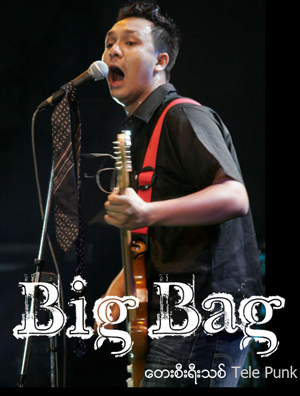 |
| Kyar Pauk, a well-known punk rock musician and a medical doctor |
Q: How did you feel seeing so many patients?
A: I was really grateful to Ko Kyaw Thu and Ko Min Htin Ko Ko Gyi for taking me there. I have got one more place to help. Otherwise, I wouldn't know it even existed.
Q: Can you do something to make people more aware of such places?
A: The first thing is the media. People don't know where HIV/AIDS patients live. More people should be aware of such places. There should be bold raising funds projects presented through magazines, journals and newspapers. I'd like to say it is not about politics. The patients there are very vulnerable in their condition, if something comes up. I didn't go there as an artist, but as a medical doctor. I wanted to know what their needs were. I wanted to see with my own eyes.
Q: What can you do to make it more well-known?
A: I have been thinking about that. Some people want to set up an online donation group to raise more funds. Many potential donors can access the Internet, so it could work. For the time being, that's maybe the best option.
Q: How can you as a medical doctor contribute to the patients?
A: I can't say exactly. It depends on how much I can be involved. I will volunteer at the Tukha Free Medical Service Clinic two days per week at the end of December. I have requested to work at the clinic for some time. I also told the patients at the shelter to come to the clinic if they have oral problems. Oral health is important to nurture in order to maintain their immune systems.
Q: Do you think it's easier for well-known artists to get involved in such projects.?
A: It could be related to people knowing that I'm a singer. Otherwise, people might ask who I am and what I wanted to do. Now it is so much easier. People know that I am a medical doctor. For example, after Cyclone Nargis, once we arrived in the cyclone- affected areas, we could give treatment without any delay. It was useful to be well known.
Q: Do you think young people should be more involved in social welfare activities?
A: Normally, I don't really pay attention to what other people are doing. I usually work with a small team. When Nargis struck Irrawaddy Division, Ko Nay Myo Say (artist), Ko Mg Mg Zaw Latt (musician) and myself, and other medical professionals, went to help. We rented a boat by ourselves. We only concentrated on what we were doing. If you ask me what other people are doing, I know almost nothing.
Q: Can celebrities do something to get more people involved?
A: My weak point is that I don't want to push other people. We should not force people to donate as far as that goes. Some donate to elders' centers or pagodas or other things. In my view, donations to needy places that are not well known is the most effective. I don't donate to religion a lot. I believe it is more effective to go personally to such places. I want more self-awareness and direct experience on my part.
Actually, I planned to go the the shelter today, but I couldn’t get out as there was road-construction around my house. I will bring medicine on my next visit. I've asked my friends and fellow medical doctors to contribute either with money or volunteer services.
Q: How do you see the patients needs as a result of your visit?
A: Generally, it's good. They need to pay more attention to oral care. In terms of morale, they are happy living there. I found two patients whose health had deteriorated and perhaps they were in an advanced stage of illness. This was only a guess since I didn't have the results of a blood test.