
| By YENI | Saturday, April 10, 2010 |
Thingyan, Burma's traditional New Year's water festival, starts on Wednesday, and military junta chief Snr-Gen Than Shwe and his family are already rolling up their sleeves to celebrate the five-day holiday in the capital Naypyidaw.
This year, Than Shwe's business cronies will sponsor all the festive activities in Naypyidaw. Several members of the military top brass, delegations from the respective government ministries and major businessmen will make appearances, as well as many of the country's top pop singers and traditional dancers.
Than Shwe may see the festival as a celebration of the near completion of his seven-step “road map to democracy.”
|
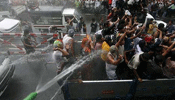
 Slide Show (
According to a source in Rangoon, Than Shwe's grandson will host his own pavilion on Prome Road near Inya Lake in Rangoon, bypassing rules laid down by the Yangon [Rangoon] City Development Committee (YCDC) and the SPDC Rangoon Division.
Many rich kids in Rangoon—notably Phyoe Tay Za and Htet Tay Za, the sons of Burmese tycoon Tay Za—will join in the clubhouse atmosphere alongside Nay Shwe Thway Aung, the source said.
It’s a time of fun, as the late Burmese author Khin Myo Chit wrote, “to have nice clean fun with dear friends, sprinkling scented water on one another … all the teasing and playing and joking go with the spirit of the season.”
Unfortunate then that Thingyan is severely restricted for the common people of Burma.
The YCDC announced no less than 39 rules governing participants in the water festival in Rangoon. On top of all the other restrictions, the YCDC is limiting the location of pavilions. Rangoon's youngsters are not allowed to build pavilions along University Avenue and Inya Road, the venues where the crowd usually flocks.
According to YCDC restrictions, pavilions must be given Burmese names, pavilion decorations must be designed to showcase Burmese art and culture, pavilion workers and guests must wear traditional Burmese clothing, pavilions must only serve traditional Burmese food and pavilion workers and guests must dance in a manner that reflects Burmese culture.
In fact, Thingyan—which has long since evolved from a simple purification ceremony into one of the world’s wildest annual events—has been increasingly commercialized, with major companies sponsoring pop concerts, DJs, dances and water-throwing events.
Ironically, many fun-loving citizens will simply have to stand back and watch as Than Shwe's grandson and his gangster friends flaunt the rules and their wealth in their private pavilion. The rules do not apply to them, of course.
The Rangoon pavilion permit committee announced that it will only issue 46 pavilion permits to residents and private companies. Last year, there were more than 200 pavilions built in Rangoon for the water festival.
In Mandalay, the most famous location for its traditional colorful performances and fun activities during Thingyan, there will be just 39 pavilions this year. Last year there were 110.
“The generals are trying to discourage us,” a local man said. “Nowadays, Naypyidaw is above all else.”
Thingyan is not all fun and games. It is a time for taking stock of the past year and making the most of the few remaining days before the arrival of the new year, according to Burmese tradition. Apart from the traditional water-throwing festival, Burmese people visit pagodas and monasteries to make merit and keep precepts, pay respect to the elderly, and do charitable work. It’s also a time of rest and recreation after the year’s labors.
Burmese abroad will also be celebrating. Water festivals abroad are generally community gatherings, featuring singing, dancing and traditional food.
Astrologers are also invited along to give blessings at this special time of year.
The origin of Thingyan is from Hinduism—the new year signified by the Princess Devi passing on the the Brahma's head to the next Devi. The Brahma, the supreme eternal deity whose essence makes up the cosmos, was considered so powerful that if his head were thrown into the sea it would dry up immediately. If it were thrown onto land it would be scorched. If it were thrown up into the air the sky would burst into flames—hence the head is protected by the hands of the princess and passed on year after year.
Thingyan-sa, the annual almanac broadsheet predicting what lies ahead in the coming year, which is published by the state-sponsored Myanmar Calendar Advisory Member, reads this year that Burma will be burdened with sorrow.
“The Devi who will accept Brahma's head this year is crying,” San Zarni Bo, one of Burma's leading astrologers, told The Irrawaddy. “It means that the country will be sad if something changes this year.”
The Brahma's head, often whispered by Burmese to be the symbol of the military junta, seems to be giving grief to the weeping princess. Perhaps she is finding it like a “hot potato” with no one to pass it to.