
| By YENI | OCTOBER, 2009 - VOLUME 17 NO.7 |
Most Karen refugees hope to return to Burma one day
Holding the youngest of her four grandchildren in her arms, 60-year-old Bi Mae said: “If there is peace again, we will go back to our village.”
Bi Mae and the four children fled to Thailand in July to escape the fighting in her Karen homeland, together with more than 500 other refugees.
Their home now is a makeshift bamboo hut in a temporary refugee camp at Tha Song Yang near the Thai-Burmese border. Since the beginning of June, fierce clashes between a joint force of Burmese government troops and their local allies, the Democratic Karen Buddhist Army (DKBA), and their traditional foe, the Karen National Liberation Army (KNLA), have forced around 4,000 Karen villagers to flee to Thailand.
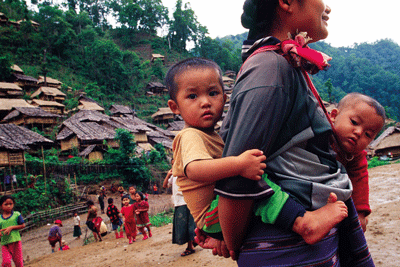 |
| A Karen woman brings her children to a ceremony marking International Refugee Day at Mae La Oon camp. (Photo: MASARU GOTO/TBBC) |
They boosted the number of refugees admitted to camps along the Thai-Burmese border to 134,000. A further 50,000 have been resettled in the US and other Western countries. Most of those still in the camps dream of being able to return home to Burma one day.
For many long-time residents of the camps, the dream has faded. The flow of refugees into Thailand began a generation ago, in 1984, when Burmese government forces began a push into Karen rebel-held territory, uprooting 10,000 villagers and forcing them to seek safety across the nearby Thai border.
The first arrived in January 1984, crossing the Moei River into Thailand’s Tak Province and setting up camp there.
Although Thailand was not—and is still not—a signatory to UN conventions on refugees, it agreed to give shelter to the desperate Karen, following an independent humanitarian policy that it had also applied for several years to refugees from Cambodia, Laos and Vietnam. In 1984, it was already hosting some 350,000 refugees.
In February 1984, under increasing pressure to provide the Karen with food and shelter, the Thai Ministry of the Interior turned for help to voluntary agencies working with Cambodian, Laotian and Vietnamese refugees on Thailand’s eastern border.
The agencies, grouped together as the Committee for Coordination of Services to Displaced Persons in Thailand, (CCSDPT) quickly responded and sent a mission to organize food supplies.
Like the Karen refugees themselves, the agencies and the Thai government thought the new arrivals from Karen State would soon be able to return to their homes.
The crisis spread, however, and Mon refugees were soon arriving across Thailand’s southern border with Burma, bringing with them horrifying accounts of abuses by the Burmese government soldiers—razed villages, rape, torture, summary execution, forced labor.
International agencies such as the Office of the United Nations High Commissioner for Refugees (UNHCR) could only look on, powerless to assist the displaced and terrorized villagers on Burmese territory.
Four years later, in August 1988, events took a further dramatic turn when Burma was rocked by a national uprising. The regime’s brutal suppression of the protests sent hundreds of thousands of students and other young activists into hiding in the jungles along the Thai-Burmese border.
Many made their way to Bangkok to seek asylum, claiming refugee status under the UNHCR mandate. The refugees generally fell into two UNHCR categories—“persons fleeing fighting,” primarily ethnic Karen, Karenni and Mon, and “persons of concern,” principally ethnic people who do not feel safe at the border as well as Burmese political exiles, dissidents and student activists.
Logging contracts and other business deals between the new Burmese military regime that took power in 1988 and Thai military leaders, which were intended to create “markets from battlefields,” only increased border tensions. Bangkok abandoned its longstanding policy of tolerating Karen rebels, who had acted as a kind of buffer zone between Thailand and Burma—and Burmese government forces stepped up their presence along the Thai-Burmese border
In 1989, fierce fighting in Karenni State sent a first large influx of refugees into Mae Hong Song Province in northern Thailand. Hundreds of kilometers to the south, more Mon communities were fleeing into Thailand’s Kanchanaburi Province through the Three Pagodas Pass.
Through a cruel irony, refugees flowing into Thailand passed trucks traveling the other way to collect Burmese timber. The larger the truck convoys, the more displaced people headed for Thailand.
The border-based groups suffered their biggest psychological blow in 1995 when the Karen rebel headquarters, Manerplaw, fell to government forces after the military regime had succeeded in exploiting resentment between rank and file Buddhist Karen soldiers and their Christian leadership. Later this breakaway group became the infamous Democratic Karen Buddhist Army, which was used by the regime to spearhead its military operations in Karen State.
Further north, Thailand had to contend with a new influx of refugees—Shan, fleeing forced relocation programs in Shan State. Most fail to meet the criteria the Thai government uses to define its description of a refugee—and those who don’t meet the stiff requirements are regarded as economic migrants.
Shan migrants who cross the border to Thailand tend to shun camp life and infiltrate local Thai communities, hoping to find employment. With this freedom, however, comes the risk of manipulation and labor abuses—and the ever-present danger of arrest and deportation as Thailand tightens its restrictions on migrants.
Karen refugees faced a different, deadly threat as their camps came under direct military attack by the DKBA. The Thai authorities attempted to increase the refugees’ security by consolidating the smaller camps into much larger ones—notably Mae La, which is the size of a small Thai town. The UNHCR was also assigned a limited role in protecting the camps.
The DKBA attacks on the camps were overshadowed by two incidents that had a major impact on Thai refugee policy.
On October 1, 1999, five Burmese gunmen calling themselves the Vigorous Burmese Student Warriors (VBSW) seized the Burmese embassy in Bangkok, took hostages and occupied the premises for a day. Thailand’s deputy foreign minister negotiated the release of the hostages and accompanied the gunmen by helicopter to the Burmese border and freed them there.
A few months later, on January 24, 2000, the VBSW and armed Burmese from a Karen splinter group called God’s Army seized the Ratchaburi provincial hospital, holding more than 500 people hostage. They demanded that civilians from a God’s Army base be allowed to cross the border into Thailand and that the Thai army immediately cease shelling the area.
Early in the morning of January 25, Thai commandos stormed the hospital and freed the hostages. Witnesses reported that some of the attackers surrendered and were led away to a separate section of the hospital compound. Shortly afterwards, the bodies of 10 attackers were displayed outside the hospital.
Following these two incidents, the Thai government instituted measures that increasingly placed Burmese refugees at risk. In November 1999, the government announced that by the end of 2000 it planned to close the Maneeloy Student Center, a refugee camp primarily housing Burmese dissident refugees in Ratchaburi Province, and pressed Western countries to accept its residents for resettlement.
The Thai authorities said all Burmese refugees in Bangkok and other urban areas should move to the border, warning that those who failed to do so would be considered illegal immigrants and be deported.
In 1999, the first formal registration of border-based refugees was carried out by the UNHCR and the Interior Ministry’s Provincial Admissions Boards (PABs) were set up to determine the status of future arrivals, who had to meet the same stiff requirements to qualify for acceptance.
Registered refugees were offered temporary asylum in Thailand, receiving food, shelter and medical care. They were confined in camps and subject to repatriation when the situation in their homeland was judged to have returned to normal. There was no third-country resettlement program at that time.
Pressure on the Thai authorities continued to grow as new waves of refugees reached Thailand and as inmates rejected by the PABs continued to live in the camps.
In 2004-5, the Thai Interior Ministry, with UNHCR support, carried out a census of the entire refugee population, re-registering 102,992 persons from the 1999 exercise and identifying 34,061 others who had arrived since that time—a total of 136,053. Since then the PABs have been considering the cases of the 2005 unregistered caseload and between October 2005 and December 2008, they regularized the status of some 35,729 persons, including approximately 2,131 who were screened in 2008.
In 2005, the Thai government agreed to allow resettlement from the camps on the Thai-Burma border to Western countries, mainly the US. The resettlement program relieved some pressure on the camps, but new problems arose as the prospect of embarking on new lives in the West drew many applicants who could not be regarded as true refugees.
The departure of approved candidates for resettlement also failed to keep pace with the number of new arrivals in the camps,
“Although increasing numbers of refugees are being resettled in third countries, camp populations are going up,” says Jack Dunford, executive director of the Thailand Burma Border Consortium (TBBC), the foremost alliance of NGOs working for humanitarian relief to Burmese refugees.
“We do believe that certain refugees should be resettled—vulnerable people and particularly those who underwent traumatic experiences in Burma and for whom return to their homeland would be too painful,” he said.
Registering the refugees is an increasingly burdensome task, and the camps currently hold 42,000 unregistered residents. In a move to speed up registration and better identify genuine refugees, the MOI recently introduced a “pre-screening” process, launching it as a pilot project in four border camps—Tham Hin, Ban Don Yang, Nu Po and Site 1.
The pilot project was due to be completed in September. If successful, the scheme will be extended to all nine refugee camps.
At the same time, the TBBC also established its own database of camp residents in an attempt to determine as accurately as possible the number of people it has to feed. It’s a mathematical challenge—at the end of June, for instance, the combined population of the camps calculated by the UNHCR was 112,755, while the TBBC’s housekeeping records showed it was supporting 134,401 residents.
Ration books have now been introduced in the camps, ensuring that all registered refugees receive their daily quota, meager though it is. When the global economic crisis hit last year, rations were cut—and even soap was struck from the list of allotted necessities.
In the face of such stringencies, camp morale dropped to new lows. Cases of camp violence, particularly domestic abuse, rose. So did suicides.
Many new arrivals risked death by venturing back into Burma to check on property and livestock they had left behind.
“If Burmese soldiers or DKBA troops see them they’ll shoot,” said Chaklo, a member of the Karen Youth Organization, one of the community-based organizations helping new arrivals. “They think maybe they are KNLA men burying landmines. We hear the sound of gunfire every day.”
The black mood that has increasingly crept over the camps spread to the donor organizations, and a new term came into being—“donor fatigue.” Despite the encouraging results of the resettlement program, there seemed to be no end to the refugee problem and some sources of funding began to seek alternative ways of dealing with it.
Bangkok-based European diplomats confirmed that there is a desire within the European Commission (EC) to devote proportionately more humanitarian aid to groups and projects inside Burma than to refugee camps in Thailand. Approaches were made to the Thai government to create employment possibilities for the refugees and integrate them in Thailand’s education and health systems. “Self-reliance” was the catchword.
In 2006, a small breakthrough was achieved when Thailand’s Interior Ministry gave the green light to NGOs to expand vocational and skills training programs in the camps designed to create opportunities for generating income.
The military coup that year brought progress to a near halt, however, and only a handful of income-producing projects have so far been started, including agricultural schemes outside Mae La and Tham Hin camps. A small number of refugees are being considered for entry to Thai universities.
Thailand’s new Democrat-led government is proving to be more receptive to the TBBC proposals, and there’s now a mood of cautious optimism in the camps that the talks between the TBBC and Thai government departments could bring results.
During one official Thai government visit to the site of a new refugee camp in July, Tassana Vichaithanapat, director of the Interior Ministry’s foreign affairs division of the operations center for displaced persons from MOI, said Bangkok was trying to find a durable solution and urged international agencies to maintain their support for refugees from Burma.
For the TBBC’s Jack Dunford there is only one durable solution—a change of government in Rangoon and an end to the present regime’s attempt to control Burma’s eastern border regions by armed conquest.
“The Burma Army wants total control and it doesn’t care how long that takes,” Dunford said. “It’s like a foreign army of occupation.
“We are now at a very, very crucial stage, with the armed ethnic groups resisting the regime’s demand to become border guards under the control of the Burma Army and the DKBA. We could be seeing an influx of 5,000 to 10,000 new refugees.”
Outside Dunford’s central Bangkok office, rain was pelting down. A few hundred kilometers northwest of the Thai capital, the Thai-Burmese border region was also in the midst of the annual monsoon.
Across the border, there were vain hopes that the monsoon rain would hamper offensives by government forces and the DKBA. On the Thai side, however, the heavy rain was bringing more misery to the refugee camps—slicing through the thin thatch of the cramped huts and turning the unpaved paths between them into mud.
“You can well imagine the despair such times bring,” said a Western diplomat, expressing his own frustration at the intractable refugee problem.